Ch 01: Units, Physical Quantities & Vectors
Young & Freedman Calc - University Physics 14th Edition
Young & Freedman Calc14th EditionUniversity PhysicsISBN: 9780321973610Not the one you use?Change textbook
Chapter 1, Problem 1.4

The density of gold is 19.3 g/cm3. What is this value in kilograms per cubic meter?

Verified step by step guidance
1
Understand the conversion factors: 1 gram (g) is equal to 0.001 kilograms (kg), and 1 cubic centimeter (cm³) is equal to 0.000001 cubic meters (m³).
Convert the density from grams per cubic centimeter to kilograms per cubic centimeter by multiplying 19.3 g/cm³ by 0.001 kg/g.
Convert the density from kilograms per cubic centimeter to kilograms per cubic meter by dividing the result by 0.000001 m³/cm³.
Combine the conversion steps: Multiply 19.3 by 0.001 to convert grams to kilograms, then divide by 0.000001 to convert cubic centimeters to cubic meters.
Express the final density in kilograms per cubic meter (kg/m³) using the conversion factors applied in the previous steps.

Verified video answer for a similar problem:

This video solution was recommended by our tutors as helpful for the problem above.
Video duration:
2m
Was this helpful?

Key Concepts

Here are the essential concepts you must grasp in order to answer the question correctly.

Density

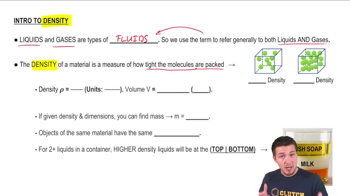
Density is a measure of mass per unit volume, typically expressed in units such as grams per cubic centimeter (g/cm³) or kilograms per cubic meter (kg/m³). It is a fundamental property of materials that indicates how much mass is contained in a given volume.
Recommended video:
Guided course
8:13
Intro to Density

Unit Conversion

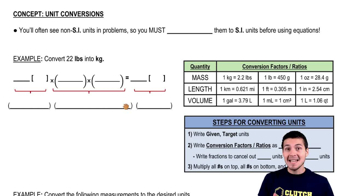
Unit conversion involves changing measurements from one unit to another, using conversion factors. In this context, converting density from g/cm³ to kg/m³ requires understanding that 1 g/cm³ equals 1000 kg/m³, due to the conversion factors of 1 gram = 0.001 kilograms and 1 cm³ = 0.000001 m³.
Recommended video:
Guided course
07:46
Unit Conversions

Metric System

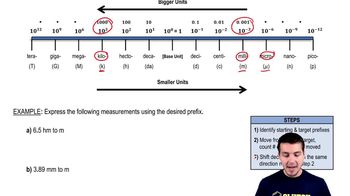
The metric system is a decimal-based system of measurement used worldwide, which includes units such as meters, liters, and grams. Understanding the metric system is crucial for performing conversions between different units, as it relies on powers of ten for scaling between units.
Recommended video:
Guided course
06:06
Metric Prefixes