
Ch 05: Applying Newton's Laws
Young & Freedman Calc - University Physics 14th Edition
Young & Freedman Calc14th EditionUniversity PhysicsISBN: 9780321973610Not the one you use?Change textbook
Chapter 5, Problem 28b

A box of bananas weighing 40.0 40.0 N rests on a horizontal surface. The coefficient of static friction between the box and the surface is 0.400.40, and the coefficient of kinetic friction is 0.200.20. What is the magnitude of the friction force if a monkey applies a horizontal force of 6.06.0 N to the box and the box is initially at rest?

Verified step by step guidance
1
Determine the maximum static friction force using the formula: fmax=μsN, where μs is the coefficient of static friction and N is the normal force. Here, N equals the weight of the box, which is 40.0 N.
Substitute the given values into the formula: fmax=0.40×40.0. This will give the maximum static friction force.
Compare the applied force (6.0 N) to the maximum static friction force calculated in the previous step. If the applied force is less than or equal to the maximum static friction force, the box will not move, and the friction force will equal the applied force.
If the applied force exceeds the maximum static friction force, the box will start moving. In this case, the friction force will transition to kinetic friction, which is calculated using the formula: fk=μkN, where μk is the coefficient of kinetic friction.
Substitute the given values into the kinetic friction formula if needed: fk=0.20×40.0. This will give the kinetic friction force if the box is in motion.

Verified video answer for a similar problem:

This video solution was recommended by our tutors as helpful for the problem above.
Video duration:
7m
Was this helpful?

Key Concepts

Here are the essential concepts you must grasp in order to answer the question correctly.

Static Friction

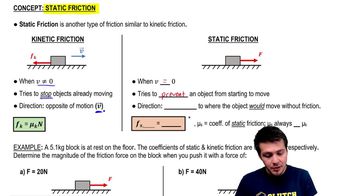
Static friction is the force that resists the initiation of sliding motion between two surfaces in contact. It acts when an object is at rest and is proportional to the normal force and the coefficient of static friction. In this scenario, the maximum static friction force can be calculated using the formula: F_static_max = μ_static * N, where μ_static is the coefficient of static friction and N is the normal force.
Recommended video:
Guided course
08:11
Static Friction & Equilibrium

Normal Force

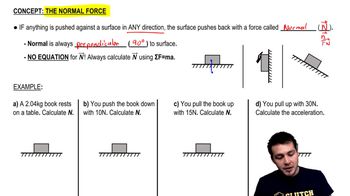
The normal force is the perpendicular force exerted by a surface to support the weight of an object resting on it. It acts in the opposite direction to gravity and is equal to the weight of the object when on a horizontal surface. In this case, the normal force acting on the box of bananas is equal to its weight, which is 40.0 N.
Recommended video:
Guided course
08:17
The Normal Force

Friction Force

The friction force is the force that opposes the relative motion of two surfaces in contact. It can be static or kinetic, depending on whether the surfaces are at rest or sliding past each other. When a horizontal force is applied to the box, the friction force will equal the applied force until it reaches the maximum static friction, which determines whether the box will move or remain at rest.
Recommended video:
Guided course
08:11
Static Friction & Equilibrium
Related Practice
Textbook Question

A box of bananas weighing 40.0 40.0 N rests on a horizontal surface. The coefficient of static friction between the box and the surface is 0.400.40, and the coefficient of kinetic friction is 0.200.20. What minimum horizontal force must the monkey apply to keep the box moving at constant velocity once it has been started?

1710
views
Textbook Question

A box of bananas weighing 40.040.0 N rests on a horizontal surface. The coefficient of static friction between the box and the surface is 0.400.40, and the coefficient of kinetic friction is 0.200.20. If the monkey applies a horizontal force of 18.018.0 N, what is the magnitude of the friction force and what is the box's acceleration?

1715
views
Textbook Question

A box of bananas weighing 40.0 40.0 N rests on a horizontal surface. The coefficient of static friction between the box and the surface is 0.400.40, and the coefficient of kinetic friction is 0.200.20. What minimum horizontal force must the monkey apply to start the box in motion?

1600
views
1
rank
Textbook Question

A 5.005.00-kg crate is suspended from the end of a short vertical rope of negligible mass. An upward force F(t)F(t) is applied to the end of the rope, and the height of the crate above its initial position is given by y(t)=y(t) = (2.802.80 m/s)t + (0.6100.610 m/s3)t3. What is the magnitude of FF when t=4.00t = 4.00 s?

203
views
Textbook Question

In a laboratory experiment on friction, a 135135-N block resting on a rough horizontal table is pulled by a horizontal wire. The pull gradually increases until the block begins to move and continues to increase thereafter. Figure E5.265.26 shows a graph of the friction force on this block as a function of the pull. Identify the regions of the graph where static friction and kinetic friction occur.

2748
views
Textbook Question

A box of bananas weighing 40.0 40.0 N rests on a horizontal surface. The coefficient of static friction between the box and the surface is 0.400.40, and the coefficient of kinetic friction is 0.200.20. If no horizontal force is applied to the box and the box is at rest, how large is the friction force exerted on it?

1842
views
1
rank