Ch 42: Molecules and Condensed Matter
Young & Freedman Calc - University Physics 14th Edition
Young & Freedman Calc14th EditionUniversity PhysicsISBN: 9780321973610Not the one you use?Change textbook
Chapter 42, Problem 17a

The maximum wavelength of light that a certain silicon photocell can detect is 1.111.11 mm. What is the energy gap (in electron volts) between the valence and conduction bands for this photocell?

Verified step by step guidance
1
Step 1: Understand the relationship between the wavelength of light and its energy. The energy of a photon is given by the equation: E=hc/λ, where E is the energy of the photon, h is Planck's constant (6.626×1034 J·s), c is the speed of light (3.00×10 m/s), and λ is the wavelength of the light.
Step 2: Convert the given wavelength from millimeters to meters. Since 1 mm = 103 m, the wavelength λ is 1.11×10³ m.
Step 3: Substitute the values of h, c, and λ into the equation E=hc/λ to calculate the energy of the photon in joules.
Step 4: Convert the energy from joules to electron volts (eV). Use the conversion factor: 1 eV = 1.602×10¹⁹ J.
Step 5: The calculated energy in electron volts represents the energy gap between the valence and conduction bands for the silicon photocell. This is the final result.

Verified video answer for a similar problem:

This video solution was recommended by our tutors as helpful for the problem above.
Video duration:
5m
Was this helpful?

Key Concepts

Here are the essential concepts you must grasp in order to answer the question correctly.

Energy Gap

The energy gap, or band gap, is the energy difference between the valence band and the conduction band in a semiconductor. It determines the energy required for an electron to transition from a bound state in the valence band to a free state in the conduction band, allowing for electrical conduction. The size of the energy gap influences the material's electrical and optical properties, including its ability to absorb light.
Recommended video:
Guided course
04:10
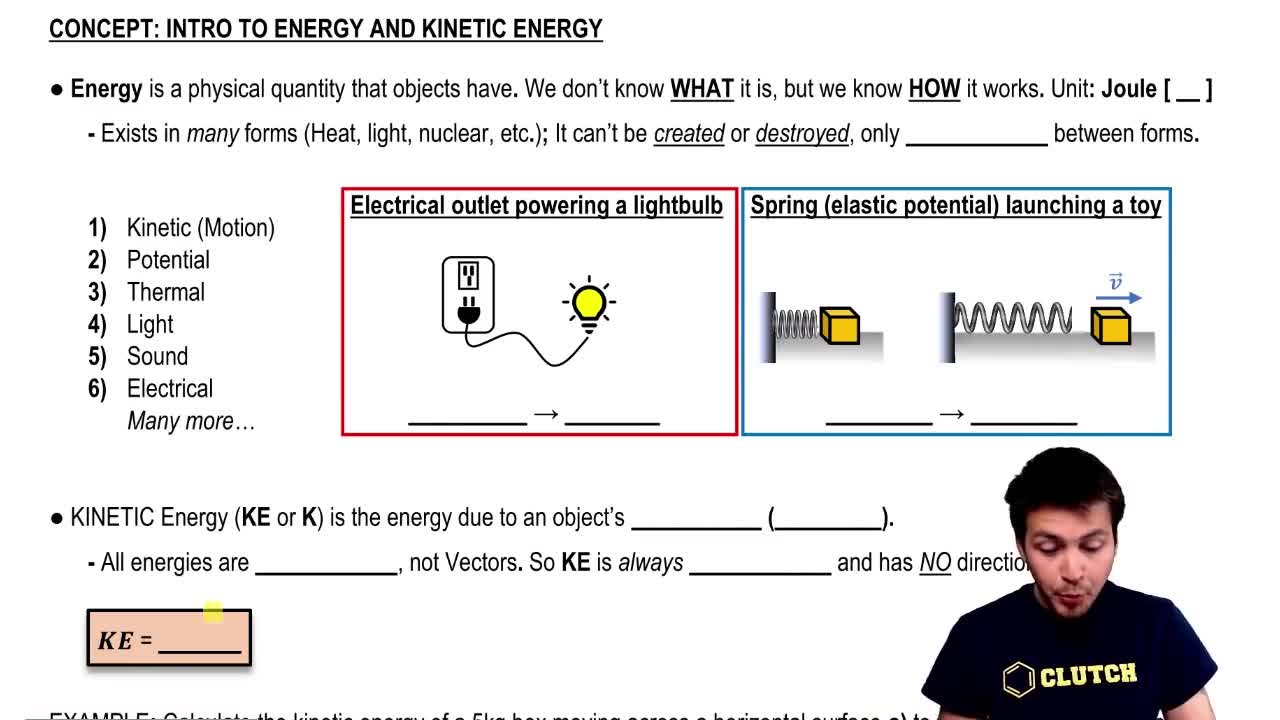
Intro to Energy & Types of Energy

Photon Energy

Photon energy is the energy carried by a single photon, which can be calculated using the equation E = hc/λ, where E is energy, h is Planck's constant, c is the speed of light, and λ is the wavelength. In the context of the photocell, the maximum wavelength of light it can detect corresponds to the minimum energy required to excite an electron across the energy gap. Thus, understanding photon energy is crucial for determining the energy gap.
Recommended video:
Guided course
04:10
Intro to Energy & Types of Energy

Semiconductor Physics

Semiconductor physics studies materials that have electrical conductivity between that of conductors and insulators. In semiconductors like silicon, the behavior of charge carriers (electrons and holes) is influenced by the energy gap. The properties of semiconductors are essential for understanding devices like photocells, which rely on the absorption of light to generate electrical signals.
Recommended video:
Guided course
03:18
Introduction to Units & the SI System
Related Practice
Textbook Question

Calculate the density of states g(E)g(E) for the free-electron model of a metal if E=7.0E = 7.0 eV and V=1.0V = 1.0 cm3. Express your answer in units of states per electron volt.

2208
views

Textbook Question

The rotational energy levels of CO are calculated in Example 42.242.2. If the energy of the rotating molecule is described by the classical expression K=(12)Iω2K=(\(\frac\)12)I\(\omega\)^2, for the l=1 l = 1 level, what is the rotational period (the time for one rotation)?

206
views
Textbook Question

Silver has a Fermi energy of 5.485.48 eV. Calculate the electron contribution to the molar heat capacity at constant volume of silver, CVC_V, at 300300 K. Express your result as a multiple of RR.

1500
views
Textbook Question

At the Fermi temperature TFT_F, EF=kTFE_F = kT_F (see Exercise 42.2242.22). When T=TFT = T_F, what is the probability that a state with energy E=2EFE = 2E_F is occupied?

1458
views
Textbook Question

The average kinetic energy of an ideal-gas atom or molecule is (32)kT\(\left\)(\(\frac\)32\(\right\))kT, where TT is the Kelvin temperature (Chapter 1818). The rotational inertia of the H2 molecule is 4.6×10484.6\(\times\)10^{-48} kg-m2. What is the value of TT for which (32)kT\(\left\)(\(\frac\)32\(\right\))kT equals the energy separation between the l=0l = 0 and l=1l = 1 energy levels of H2? What does this tell you about the number of H2 molecules in the l=1l = 1 level at room temperature?

1896
views
Textbook Question

Potassium bromide (KBr) has a density of 2.75×1032.75\(\times\)10^3 kg/m3 and the same crystal structure as NaCl. The mass of a potassium atom is 6.49×10266.49\(\times\)10^{-26} kg, and the mass of a bromine atom is 1.33×10251.33\(\times\)10^{-25} kg. Calculate the average spacing between adjacent atoms in a KBr crystal.

312
views