
Ch 05: Applying Newton's Laws
Young & Freedman Calc - University Physics 14th Edition
Young & Freedman Calc14th EditionUniversity PhysicsISBN: 9780321973610Not the one you use?Change textbook
Chapter 5, Problem 11b

An astronaut is inside a 2.25×1062.25 × 10^6 kg rocket that is blasting off vertically from the launch pad. You want this rocket to reach the speed of sound (331331 m/s) as quickly as possible, but astronauts are in danger of blacking out at an acceleration greater than 4g4g. What force, in terms of the astronaut's weight ww, does the rocket exert on her? Start with a free-body diagram of the astronaut.

Verified step by step guidance
1
Start by drawing a free-body diagram for the astronaut. The forces acting on her are: (1) the upward normal force exerted by the rocket (F_rocket), and (2) the downward gravitational force (F_gravity = w, where w is the astronaut's weight).
Apply Newton's second law of motion: \( F_{net} = ma \), where \( F_{net} \) is the net force acting on the astronaut, \( m \) is her mass, and \( a \) is her acceleration. The net force is given by \( F_{net} = F_{rocket} - F_{gravity} \).
Substitute \( F_{gravity} = w \) and \( a = 4g \) (since the maximum safe acceleration is 4 times the acceleration due to gravity, \( g \)). This gives \( F_{rocket} - w = m(4g) \).
Express the astronaut's mass \( m \) in terms of her weight \( w \): \( m = \frac{w}{g} \). Substitute this into the equation: \( F_{rocket} - w = \frac{w}{g}(4g) \).
Simplify the equation to solve for \( F_{rocket} \): \( F_{rocket} = w + 4w = 5w \). Thus, the rocket exerts a force equal to 5 times the astronaut's weight on her.

Verified video answer for a similar problem:

This video solution was recommended by our tutors as helpful for the problem above.
Video duration:
5m
Was this helpful?

Key Concepts

Here are the essential concepts you must grasp in order to answer the question correctly.

Free-Body Diagram

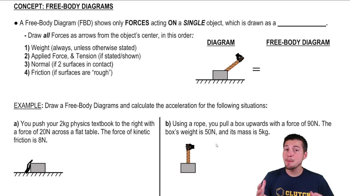
A free-body diagram is a graphical representation used to visualize the forces acting on an object. In this context, it helps identify the forces acting on the astronaut, including gravitational force and the thrust force from the rocket. By analyzing these forces, one can determine the net force and the resulting acceleration experienced by the astronaut.
Recommended video:
Guided course
08:42
Free-Body Diagrams

Newton's Second Law of Motion

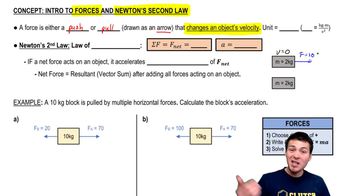
Newton's Second Law states that the acceleration of an object is directly proportional to the net force acting on it and inversely proportional to its mass, expressed as F = ma. This principle is crucial for calculating the force exerted by the rocket on the astronaut, as it allows us to relate the astronaut's weight and the required acceleration to reach the speed of sound without exceeding safe limits.
Recommended video:
Guided course
06:54
Intro to Forces & Newton's Second Law

Acceleration due to Gravity

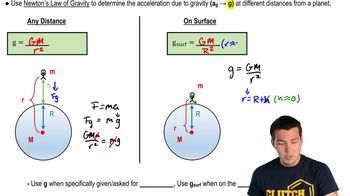
Acceleration due to gravity (g) is the acceleration experienced by an object due to Earth's gravitational pull, approximately 9.81 m/s². In this scenario, the astronaut's weight (w) is the force due to gravity acting on her mass. Understanding this concept is essential for determining the total force exerted by the rocket, as it must counteract both the gravitational force and provide additional force for the desired acceleration.
Recommended video:
Guided course
05:20
Acceleration Due to Gravity
Related Practice
Textbook Question

A man pushes on a piano with mass 180180 kg; it slides at constant velocity down a ramp that is inclined at 19.0°19.0° above the horizontal floor. Neglect any friction acting on the piano. Calculate the magnitude of the force applied by the man if he pushes parallel to the incline.

2008
views
Textbook Question

Three sleds are being pulled horizontally on frictionless horizontal ice using horizontal ropes (Fig. E5.145.14). The pull is of magnitude 190190 N. Find the acceleration of the system.

2429
views
Textbook Question

A man pushes on a piano with mass 180180 kg; it slides at constant velocity down a ramp that is inclined at 19.0°19.0° above the horizontal floor. Neglect any friction acting on the piano. Calculate the magnitude of the force applied by the man if he pushes parallel to the floor.

4636
views
Textbook Question

On September 8, 2004, the Genesis spacecraft crashed in the Utah desert because its parachute did not open. The 210210-kg capsule hit the ground at 311311 km/h and penetrated the soil to a depth of 81.081.0 cm. What was its acceleration (in m/s2 and in g's), assumed to be constant, during the crash?

1585
views
Textbook Question

An astronaut is inside a 2.25×1062.25 × 10^6 kg rocket that is blasting off vertically from the launch pad. You want this rocket to reach the speed of sound (331331 m/s) as quickly as possible, but astronauts are in danger of blacking out at an acceleration greater than 4g4g. What is the maximum initial thrust this rocket's engines can have but just barely avoid blackout? Start with a free-body diagram of the rocket.

2499
views
1
rank
Textbook Question

On September 8, 2004, the Genesis spacecraft crashed in the Utah desert because its parachute did not open. The 210210-kg capsule hit the ground at 311311 km/h and penetrated the soil to a depth of 81.081.0 cm. What force did the ground exert on the capsule during the crash? Express the force in newtons and as a multiple of the capsule's weight.

2675
views