
Ch 20: The Second Law of Thermodynamics
Young & Freedman Calc - University Physics 14th Edition
Young & Freedman Calc14th EditionUniversity PhysicsISBN: 9780321973610Not the one you use?Change textbook
Chapter 20, Problem 30a

A box is separated by a partition into two parts of equal volume. The left side of the box contains 500500 molecules of nitrogen gas; the right side contains 100100 molecules of oxygen gas. The two gases are at the same temperature. The partition is punctured, and equilibrium is eventually attained. Assume that the volume of the box is large enough for each gas to undergo a free expansion and not change temperature. On average, how many molecules of each type will there be in either half of the box?

Verified step by step guidance
1
Understand that when the partition is punctured, the gases will mix and reach equilibrium, meaning the molecules will be evenly distributed throughout the entire box.
Recognize that the total number of molecules in the box is the sum of nitrogen and oxygen molecules, which is 500 + 100 = 600 molecules.
Since the box is divided into two equal parts, at equilibrium, each half will contain half of the total number of molecules. Therefore, each half will contain 600 / 2 = 300 molecules.
Calculate the average number of nitrogen molecules in either half of the box. Initially, there are 500 nitrogen molecules, so at equilibrium, each half will contain 500 / 2 = 250 nitrogen molecules.
Calculate the average number of oxygen molecules in either half of the box. Initially, there are 100 oxygen molecules, so at equilibrium, each half will contain 100 / 2 = 50 oxygen molecules.

Verified video answer for a similar problem:

This video solution was recommended by our tutors as helpful for the problem above.
Video duration:
2m
Was this helpful?

Key Concepts

Here are the essential concepts you must grasp in order to answer the question correctly.

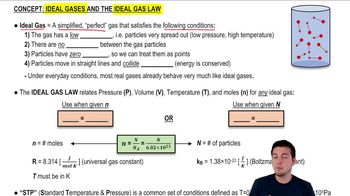
Ideal Gas Law

The Ideal Gas Law relates the pressure, volume, temperature, and number of molecules of a gas. In this scenario, the temperature remains constant, and the gases undergo free expansion, meaning the pressure and volume adjust to maintain equilibrium without changing temperature. This concept helps understand how gases distribute themselves evenly when the partition is removed.
Recommended video:
Guided course
07:21
Ideal Gases and the Ideal Gas Law

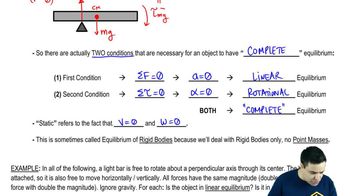
Equilibrium

Equilibrium in thermodynamics refers to a state where macroscopic properties like pressure and temperature are uniform throughout the system. When the partition is punctured, the gases mix until they reach equilibrium, meaning the molecules are evenly distributed across the entire volume of the box, resulting in an equal number of molecules in each half.
Recommended video:
Guided course
10:13
Torque & Equilibrium

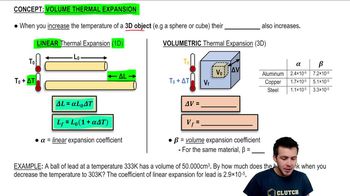
Free Expansion

Free expansion is a process where a gas expands into a vacuum or a larger volume without doing work on the surroundings and without heat exchange. In this problem, the gases expand freely when the partition is removed, maintaining their initial temperature. This concept is crucial for understanding why the temperature remains constant despite the change in volume.
Recommended video:
Guided course
05:21
Volume Thermal Expansion