
Textbook Question
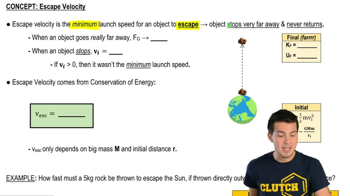
A rocket is launched straight up from the earth's surface at a speed of 15,000 m/s. What is its speed when it is very far away from the earth?
2583
views
1
comments

 Verified step by step guidance
 7:27
7:27
 08:59
08:59 03:02
03:02A rocket is launched straight up from the earth's surface at a speed of 15,000 m/s. What is its speed when it is very far away from the earth?
A recently discovered extrasolar planet appears to be rockier and denser than earth. It is 16 times as massive as earth, but its diameter is only twice that of earth. What is the free-fall acceleration on the surface of this planet?
A space station orbits the sun at the same distance as the earth but on the opposite side of the sun. A small probe is fired away from the station. What minimum speed does the probe need to escape the solar system?
Suppose we could shrink the earth without changing its mass. At what fraction of its current radius would the free-fall acceleration at the surface be three times its present value?
Two stars, one twice as massive as the other, are 1.0 light year (ly) apart. One light year is the distance light travels in one year at the speed of light, 3.00 ✕ 108 m/s . The gravitational potential energy of this double-star system is - 8.0 ✕ 1034 J. What is the mass of the lighter star?
Asteroid 253 Mathilde is one of several that have been visited by space probes. This asteroid is roughly spherical with a diameter of 53 km. The free-fall acceleration at the surface is 9.9 ✕ 10-3 m/s2. What is the asteroid's mass?