

Ch 26: Direct-Current Circuits
Young & Freedman Calc - University Physics 14th Edition
Young & Freedman Calc14th EditionUniversity PhysicsISBN: 9780321973610Not the one you use?Change textbook
Chapter 26, Problem 27b

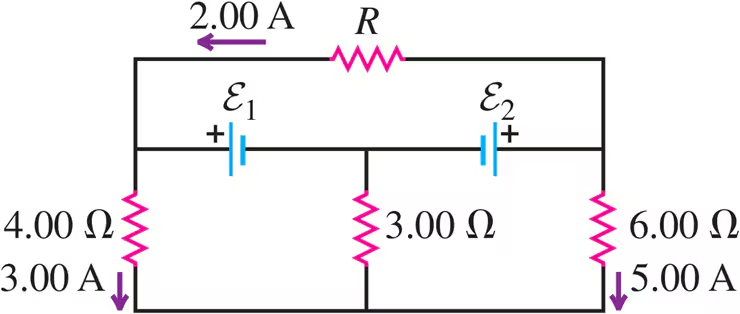
In the circuit shown in Fig. E26.27 find the unknown emfs ε1ε_1 and ε2ε_2.

Verified step by step guidance
1
Identify the components in the circuit: There are two batteries with unknown emfs (E₁ and E₂), three resistors with resistances of 8Ω, 8Ω, and 1Ω, and two currents given as 1.75A and 1.25A.
Apply Kirchhoff's loop rule to the left loop: The sum of the emfs and the voltage drops across the resistors should equal zero. The equation for the left loop is E₁ - 8Ω * 1.75A - 8Ω * 1.75A = 0.
Solve the equation from step 2 for E₁: Rearrange the equation to find the value of E₁ in terms of the given current and resistances.
Apply Kirchhoff's loop rule to the right loop: The sum of the emfs and the voltage drops across the resistors should equal zero. The equation for the right loop is E₂ - 1Ω * 1.25A - 8Ω * 1.25A = 0.
Solve the equation from step 4 for E₂: Rearrange the equation to find the value of E₂ in terms of the given current and resistances.

Verified video answer for a similar problem:

This video solution was recommended by our tutors as helpful for the problem above.
Video duration:
2m
Was this helpful?

Key Concepts

Here are the essential concepts you must grasp in order to answer the question correctly.

Kirchhoff's Loop Rule

Kirchhoff's Loop Rule states that the sum of the electromotive forces (emfs) and potential differences (voltage drops) around any closed loop in a circuit must equal zero. This principle is based on the conservation of energy, ensuring that all energy supplied by sources is used up by the resistive elements in the loop. It is essential for analyzing complex circuits with multiple loops and branches.
Recommended video:
11:15
Intro to Kirchhoff's Loop Rule

Ohm's Law

Ohm's Law is a fundamental principle in electronics and physics, stating that the current (I) through a conductor between two points is directly proportional to the voltage (V) across the two points and inversely proportional to the resistance (R) of the conductor. It is expressed as V = IR, and is crucial for calculating voltage drops across resistors in a circuit, which is necessary for applying Kirchhoff's Loop Rule.
Recommended video:
Guided course
03:07
Resistance and Ohm's Law

Series and Parallel Circuits

In a series circuit, components are connected end-to-end, so the same current flows through each component, while the total voltage is the sum of the voltages across each component. In a parallel circuit, components are connected across the same two points, so the voltage across each component is the same, while the total current is the sum of the currents through each component. Understanding these configurations helps in analyzing the circuit's behavior and applying Kirchhoff's rules effectively.
Recommended video:
Guided course
09:51
Combining Capacitors in Series & Parallel