
Ch 10: Interactions and Potential Energy
Knight Calc - Physics for Scientists and Engineers 5th Edition
Knight Calc5th EditionPhysics for Scientists and EngineersISBN: 9780137344796Not the one you use?Change textbook
Chapter 10, Problem 49b

Two blocks with masses mA and mB are connected by a massless string over a massless, frictionless pulley. Block B, which is more massive than block A, is released from height h and falls. A 1.0 kg block and a 2.0 kg block are connected by a massless string over a massless, frictionless pulley. The impact speed of the heavier block, after falling, is 1.8 m/s. From how high did it fall?

Verified step by step guidance
1
Step 1: Identify the forces acting on the system. Block A experiences a tension force upward, while Block B experiences both the tension force upward and the gravitational force downward. The net force on the system will determine the acceleration.
Step 2: Write the equations of motion for each block using Newton's second law. For Block A: T - mA * g = mA * a. For Block B: mB * g - T = mB * a. Here, T is the tension in the string, g is the acceleration due to gravity, and a is the acceleration of the system.
Step 3: Solve the two equations simultaneously to eliminate T and find the acceleration a. Add the two equations: mB * g - mA * g = (mA + mB) * a. Rearrange to solve for a: a = (mB - mA) * g / (mA + mB).
Step 4: Use kinematic equations to relate the height h to the final velocity v of Block B. The equation v² = u² + 2 * a * h applies, where u is the initial velocity (0 m/s in this case), v is the final velocity (1.8 m/s), and a is the acceleration calculated in Step 3.
Step 5: Rearrange the kinematic equation to solve for h: h = v² / (2 * a). Substitute the values of v and a into this equation to find the height from which Block B fell.

Verified video answer for a similar problem:

This video solution was recommended by our tutors as helpful for the problem above.
Video duration:
13m
Was this helpful?

Key Concepts

Here are the essential concepts you must grasp in order to answer the question correctly.

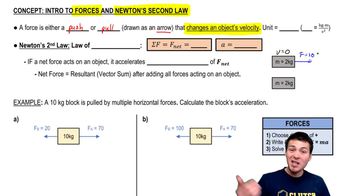
Newton's Second Law of Motion

Newton's Second Law states that the acceleration of an object is directly proportional to the net force acting on it and inversely proportional to its mass. This principle is crucial for analyzing the motion of the blocks in the pulley system, as it helps determine the forces acting on each block and how they influence their acceleration.
Recommended video:
Guided course
06:54
Intro to Forces & Newton's Second Law

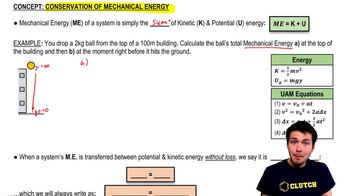
Conservation of Energy

The principle of conservation of energy states that energy cannot be created or destroyed, only transformed from one form to another. In the context of the falling block, the potential energy lost by the block as it descends is converted into kinetic energy, allowing us to relate the height from which it fell to its impact speed.
Recommended video:
Guided course
06:24
Conservation Of Mechanical Energy

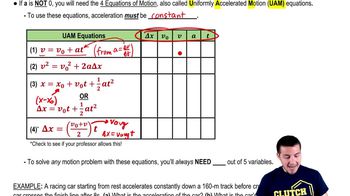
Kinematic Equations

Kinematic equations describe the motion of objects under constant acceleration. These equations can be used to relate the initial velocity, final velocity, acceleration, and displacement of the falling block. In this scenario, they are essential for calculating the height from which the heavier block fell based on its final speed.
Recommended video:
Guided course
08:25
Kinematics Equations
Related Practice
Textbook Question

A horizontal spring with spring constant 100 N/m is compressed 20 cm and used to launch a 2.5 kg box across a frictionless, horizontal surface. After the box travels some distance, the surface becomes rough. The coefficient of kinetic friction of the box on the surface is 0.15. Use work and energy to find how far the box slides across the rough surface before stopping.

2191
views
Textbook Question

A freight company uses a compressed spring to shoot 2.0 kg packages up a 1.0-m-high frictionless ramp into a truck, as FIGURE P10.52 shows. The spring constant is 500 N/m and the spring is compressed 30 cm. What is the speed of the package when it reaches the truck?

1952
views
Textbook Question

A block of mass m slides down a frictionless track, then around the inside of a circular loop-the-loop of radius R . From what minimum height h must the block start to make it around without falling off? Give your answer as a multiple of R.

2860
views
1
rank
Textbook Question

The spring shown in FIGURE P10.54 is compressed 50 cm and used to launch a 100 kg physics student. The track is frictionless until it starts up the incline. The student's coefficient of kinetic friction on the 30° incline is 0.15. What is the student's speed just after losing contact with the spring?

<Image>

2814
views
Textbook Question

Two blocks with masses mA and mB are connected by a massless string over a massless, frictionless pulley. Block B, which is more massive than block A, is released from height h and falls. Write an expression for the speed of the blocks just as block B reaches the ground.

2126
views
Textbook Question

The ice cube is replaced by a 50 g plastic cube whose coefficient of kinetic friction is 0.20. How far will the plastic cube travel up the slope? Use work and energy.

1979
views