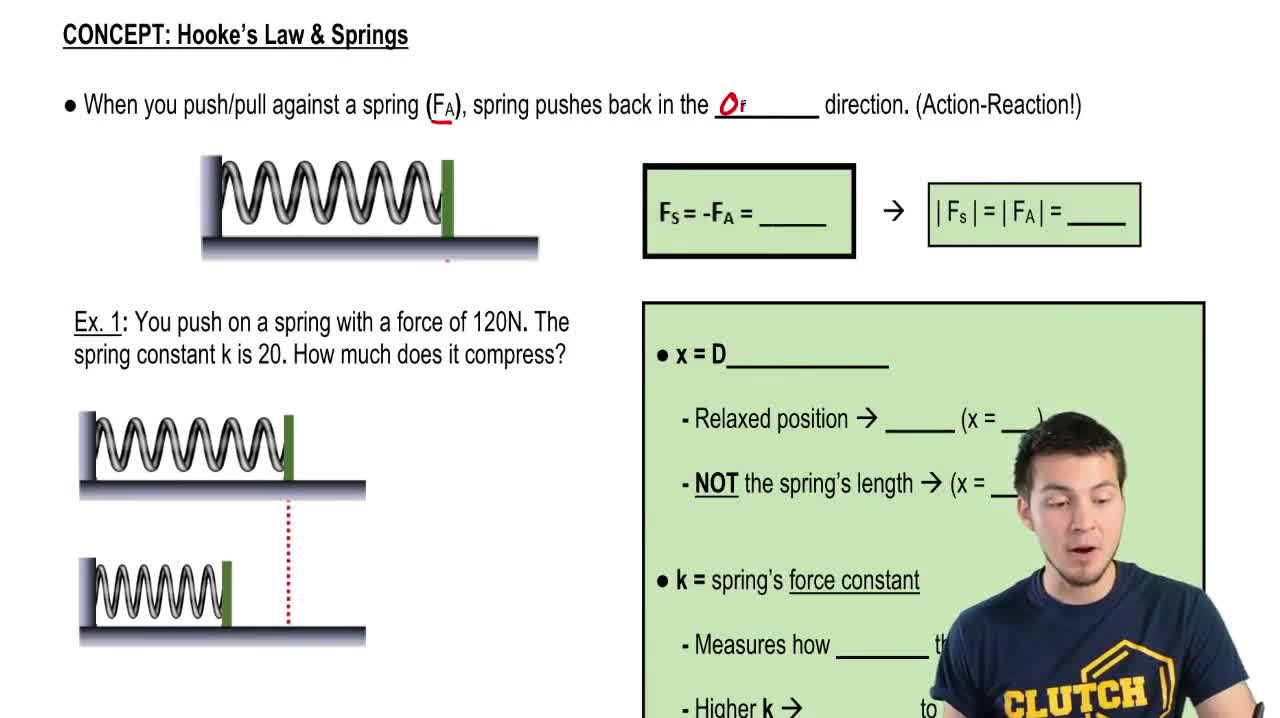
A 0.500-kg glider, attached to the end of an ideal spring with force constant k = 450 N/m, undergoes SHM with an amplitude of 0.040 m. Compute the speed of the glider when it is at x = -0.015 m.
Ch 14: Periodic Motion
Young & Freedman Calc14th EditionUniversity PhysicsISBN: 9780321973610Not the one you use?Change textbook
Chapter 14, Problem 25
A small block is attached to an ideal spring and is moving in SHM on a horizontal frictionless surface. The amplitude of the motion is 0.165 m. The maximum speed of the block is 3.90 m/s. What is the maximum magnitude of the acceleration of the block?
Verified step by step guidance1
Start by recalling the relationship between maximum speed, amplitude, and angular frequency in simple harmonic motion (SHM). The maximum speed \( v_{max} \) is given by \( v_{max} = A \omega \), where \( A \) is the amplitude and \( \omega \) is the angular frequency.
Use the given values: amplitude \( A = 0.165 \) m and maximum speed \( v_{max} = 3.90 \) m/s to solve for the angular frequency \( \omega \). Rearrange the formula to \( \omega = \frac{v_{max}}{A} \).
Calculate \( \omega \) using the values provided: \( \omega = \frac{3.90}{0.165} \). This will give you the angular frequency in radians per second.
Recall that the maximum acceleration \( a_{max} \) in SHM is given by \( a_{max} = A \omega^2 \). This formula relates the amplitude and the square of the angular frequency to the maximum acceleration.
Substitute the values of \( A \) and \( \omega \) into the formula \( a_{max} = A \omega^2 \) to find the maximum magnitude of the acceleration. This will give you the desired result.

Verified video answer for a similar problem:
This video solution was recommended by our tutors as helpful for the problem above.
Video duration:
3mWas this helpful?
Key Concepts
Here are the essential concepts you must grasp in order to answer the question correctly.
Simple Harmonic Motion (SHM)
Simple Harmonic Motion (SHM) is a type of periodic motion where an object oscillates back and forth through an equilibrium position. The motion is characterized by a restoring force proportional to the displacement from equilibrium, often described by sine or cosine functions. In SHM, the object experiences maximum speed at the equilibrium position and maximum acceleration at the points of maximum displacement.
Recommended video:
Guided course
Simple Harmonic Motion of Pendulums
Hooke's Law
Hooke's Law states that the force exerted by a spring is directly proportional to the displacement from its equilibrium position, expressed as F = -kx, where k is the spring constant and x is the displacement. This law is fundamental in understanding the restoring force in SHM, as it explains how the spring's force changes with displacement, influencing the motion's amplitude and frequency.
Recommended video:
Guided course
Spring Force (Hooke's Law)
Relationship between Speed, Amplitude, and Acceleration in SHM
In SHM, the maximum speed (v_max) and maximum acceleration (a_max) are related to the amplitude (A) and angular frequency (ω) of the motion. The maximum speed is given by v_max = Aω, and the maximum acceleration is a_max = Aω². These relationships help determine the maximum acceleration by using the given amplitude and maximum speed to find the angular frequency, which is crucial for solving the problem.
Recommended video:
Guided course
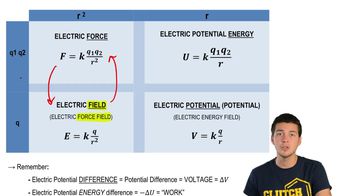
Relationships Between Force, Field, Energy, Potential
Related Practice
Textbook Question
2429
views
Textbook Question
A 0.500-kg glider, attached to the end of an ideal spring with force constant k = 450 N/m, undergoes SHM with an amplitude of 0.040 m. Compute the total mechanical energy of the glider at any point in its motion
2474
views
Textbook Question
For the oscillating object in Fig. E14.4, what is its maximum speed?
2163
views
Textbook Question
A mass on a spring has velocity as a function of time given by . What are the amplitude and the maximum acceleration of the mass?
2484
views
Textbook Question
A small block is attached to an ideal spring and is moving in SHM on a horizontal, frictionless surface. The amplitude of the motion is 0.250 m and the period is 3.20 s. What are the speed and acceleration of the block when x = 0.160 m?
2004
views
Textbook Question
For the oscillating object in Fig. E14.4, what is its maximum acceleration?
2836
views