
Ch 10: Dynamics of Rotational Motion
Young & Freedman Calc - University Physics 14th Edition
Young & Freedman Calc14th EditionUniversity PhysicsISBN: 9780321973610Not the one you use?Change textbook
Chapter 10, Problem 47a

A small 10.0-g bug stands at one end of a thin uniform bar that is initially at rest on a smooth horizontal table. The other end of the bar pivots about a nail driven into the table and can rotate freely, without friction. The bar has mass 50.0 g and is 100 cm in length. The bug jumps off in the horizontal direction, perpendicular to the bar, with a speed of 20.0 cm/s relative to the table. What is the angular speed of the bar just after the frisky insect leaps?

Verified step by step guidance
1
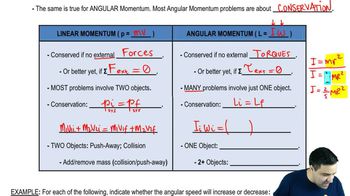
Identify the conservation principle applicable to the problem. Since there are no external torques acting on the system, angular momentum is conserved.
Calculate the initial angular momentum of the system. Initially, both the bug and the bar are at rest, so the initial angular momentum is zero.
Determine the angular momentum of the bug after it jumps. Use the formula for linear momentum, \( p = mv \), where \( m \) is the mass of the bug and \( v \) is its velocity. The angular momentum \( L \) is given by \( L = r \times p \), where \( r \) is the distance from the pivot to the point where the bug jumps off.
Calculate the angular momentum of the bar after the bug jumps. Since the initial angular momentum was zero, the angular momentum of the bar must be equal and opposite to that of the bug to conserve angular momentum.
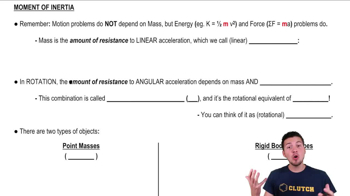
Use the relationship between angular momentum and angular speed for the bar. The angular momentum \( L \) of the bar is given by \( L = I \omega \), where \( I \) is the moment of inertia of the bar and \( \omega \) is the angular speed. Solve for \( \omega \) using the moment of inertia of a rod pivoted at one end, \( I = \frac{1}{3}mL^2 \), where \( m \) is the mass of the bar and \( L \) is its length.

Verified video answer for a similar problem:

This video solution was recommended by our tutors as helpful for the problem above.
Video duration:
8m
Was this helpful?

Key Concepts

Here are the essential concepts you must grasp in order to answer the question correctly.

Conservation of Angular Momentum

The conservation of angular momentum states that if no external torques act on a system, the total angular momentum remains constant. In this scenario, the bug's jump imparts angular momentum to the bar, and since the system is isolated (no external torques), the angular momentum before and after the jump must be equal, allowing us to calculate the bar's angular speed.
Recommended video:
Guided course
12:12
Conservation of Angular Momentum

Moment of Inertia

Moment of inertia is a measure of an object's resistance to changes in its rotation. For a uniform bar pivoting about one end, the moment of inertia is calculated using the formula I = (1/3)ML^2, where M is the mass and L is the length of the bar. This concept is crucial for determining how the bar's mass distribution affects its angular speed after the bug jumps.
Recommended video:
Guided course
11:47
Intro to Moment of Inertia

Relative Velocity

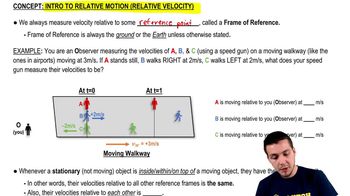
Relative velocity refers to the velocity of an object as observed from a particular frame of reference. In this problem, the bug's jump speed is given relative to the table, which is essential for calculating the change in angular momentum imparted to the bar. Understanding relative velocity helps in correctly applying the conservation of angular momentum to find the bar's angular speed.
Recommended video:
Guided course
04:27
Intro to Relative Motion (Relative Velocity)
Related Practice
Textbook Question

A uniform, 4.5-kg, square, solid wooden gate 1.5 m on each side hangs vertically from a frictionless pivot at the center of its upper edge. A 1.1-kg raven flying horizontally at 5.0 m/s flies into this door at its center and bounces back at 2.0 m/s in the opposite direction. During the collision, why is the angular momentum conserved but not the linear momentum?

1541
views
Textbook Question

A thin uniform rod has a length of 0.500 m0.500\(\text{ m}\) and is rotating in a circle on a frictionless table. The axis of rotation is perpendicular to the length of the rod at one end and is stationary. The rod has an angular velocity of 0.400 rad/s0.400\(\text{ rad/s}\) and a moment of inertia about the axis of 3.00×10³kg/m23.00\(\times\)10^{-3}\(\text{kg/m}\)^2. A bug initially standing on the rod at the axis of rotation decides to crawl out to the other end of the rod. When the bug has reached the end of the rod and sits there, its tangential speed is 0.160 m/s0.160\(\text{ m/s}\). The bug can be treated as a point mass. What is the mass of the rod.

3866
views
1
comments
Textbook Question

A uniform, 4.5-kg, square, solid wooden gate 1.5 m on each side hangs vertically from a frictionless pivot at the center of its upper edge. A 1.1-kg raven flying horizontally at 5.0 m/s flies into this door at its center and bounces back at 2.0 m/s in the opposite direction. What is the angular speed of the gate just after it is struck by the unfortunate raven?

2418
views
Textbook Question

A large wooden turntable in the shape of a flat uniform disk has a radius of 2.00 m and a total mass of 120 kg. The turntable is initially rotating at 3.00 rad/s about a vertical axis through its center. Suddenly, a 70.0-kg parachutist makes a soft landing on the turntable at a point near the outer edge. Compute the kinetic energy of the system before and after the parachutist lands. Why are these kinetic energies not equal?

2567
views
Textbook Question

A large wooden turntable in the shape of a flat uniform disk has a radius of 2.00 m and a total mass of 120 kg. The turntable is initially rotating at 3.00 rad/s about a vertical axis through its center. Suddenly, a 70.0-kg parachutist makes a soft landing on the turntable at a point near the outer edge. Find the angular speed of the turntable after the parachutist lands. (Assume that you can treat the parachutist as a particle.)

1785
views
Textbook Question

Suppose that an asteroid traveling straight toward the center of the earth were to collide with our planet at the equator and bury itself just below the surface. What would have to be the mass of this asteroid, in terms of the earth's mass M, for the day to become 25.0% longer than it presently is as a result of the collision? Assume that the asteroid is very small compared to the earth and that the earth is uniform throughout.

3898
views