
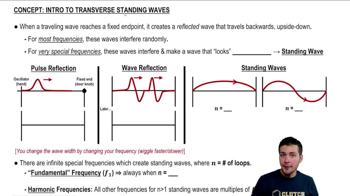
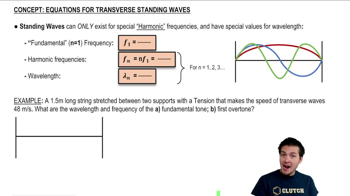
A horizontal string tied at both ends is vibrating in its fundamental mode. The traveling waves have speed , frequency , amplitude , and wavelength . Calculate the maximum transverse velocity and maximum transverse acceleration of points located at (i) , (ii) , and (iii) , from the left-hand end of the string.
A horizontal string tied at both ends is vibrating in its fundamental mode. The traveling waves have speed , frequency , amplitude , and wavelength . What is the amplitude of the motion at the points located at (i) , (ii) , and (iii) , from the left-hand end of the string?
Verified step by step guidance
Verified video answer for a similar problem:
Key Concepts
Standing Waves
Fundamental Mode
Wave Amplitude
One string of a certain musical instrument is 75.0 cm long and has a mass of 8.75 g. It is being played in a room where the speed of sound is 344 m/s. (a) To what tension must you adjust the string so that, when vibrating in its second overtone, it produces sound of wavelength 0.765 m? (Assume that the break-ing stress of the wire is very large and isn't exceeded.) (b) What frequency sound does this string produce in its fundamental mode of vibration?
A horizontal string tied at both ends is vibrating in its fundamental mode. The traveling waves have speed , frequency , amplitude , and wavelength . How much time does it take the string to go from its largest upward displacement to its largest downward displacement at the points located at (i) , (ii) , and (iii) , from the left-hand end of the string.
The wave function of a standing wave is . For the two traveling waves that make up this standing wave, find the wave speed.
