Ch 04: Newton's Laws of Motion
Young & Freedman Calc - University Physics 14th Edition
Young & Freedman Calc14th EditionUniversity PhysicsISBN: 9780321973610Not the one you use?Change textbook
Chapter 4, Problem 1

Two dogs pull horizontally on ropes attached to a post; the angle between the ropes is 60.0 60.0°. If Rover exerts a force of 270270 N and Fido exerts a force of 300300 N, find the magnitude of the resultant force and the angle it makes with Rover's rope.

Verified step by step guidance
1
Step 1: Represent the forces exerted by Rover and Fido as vectors. Rover's force vector has a magnitude of 270 N, and Fido's force vector has a magnitude of 300 N. The angle between the two vectors is given as 60.0°.
Step 2: Use the formula for the magnitude of the resultant force when two vectors are at an angle: \( F_{R} = \sqrt{F_{1}^2 + F_{2}^2 + 2F_{1}F_{2}\cos\theta} \), where \( F_{1} \) and \( F_{2} \) are the magnitudes of the forces, and \( \theta \) is the angle between them.
Step 3: Substitute the given values into the formula: \( F_{1} = 270 \, \text{N}, \, F_{2} = 300 \, \text{N}, \text{ and } \theta = 60.0° \). Calculate \( \cos\theta \) using \( \cos(60.0°) = 0.5 \).
Step 4: To find the angle \( \phi \) that the resultant force makes with Rover's rope, use the formula for the direction of the resultant vector: \( \tan\phi = \frac{F_{2}\sin\theta}{F_{1} + F_{2}\cos\theta} \). Substitute the values \( F_{1} = 270 \, \text{N}, \, F_{2} = 300 \, \text{N}, \text{ and } \theta = 60.0° \).
Step 5: Solve the equations step by step to find the magnitude of the resultant force \( F_{R} \) and the angle \( \phi \). Ensure proper handling of trigonometric functions and square roots during calculations.

Verified video answer for a similar problem:

This video solution was recommended by our tutors as helpful for the problem above.
Video duration:
9m
Was this helpful?

Key Concepts

Here are the essential concepts you must grasp in order to answer the question correctly.

Vector Addition

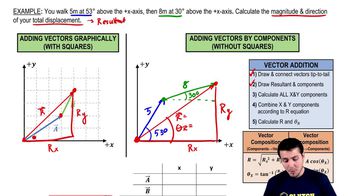
Vector addition is the process of combining two or more vectors to determine a resultant vector. In this scenario, the forces exerted by the dogs are vectors with both magnitude and direction. The resultant force can be found using the law of cosines or by breaking the vectors into their components and summing them.
Recommended video:
Guided course
07:30
Vector Addition By Components

Law of Cosines

The law of cosines relates the lengths of the sides of a triangle to the cosine of one of its angles. It is particularly useful in this problem to find the magnitude of the resultant force when two vectors are at an angle to each other. The formula is c² = a² + b² - 2ab*cos(θ), where θ is the angle between the two vectors.
Recommended video:

Resultant Force Direction

The direction of the resultant force can be determined using trigonometric functions, specifically the sine and cosine functions. By calculating the angle that the resultant makes with one of the original vectors, we can use the inverse tangent function to find this angle. This is essential for understanding how the combined forces act in relation to the individual forces.
Recommended video:
Guided course
08:17
The Normal Force