Ch 10: Interactions and Potential Energy
Knight Calc - Physics for Scientists and Engineers 5th Edition
Knight Calc5th EditionPhysics for Scientists and EngineersISBN: 9780137344796Not the one you use?Change textbook
Chapter 10, Problem 55a

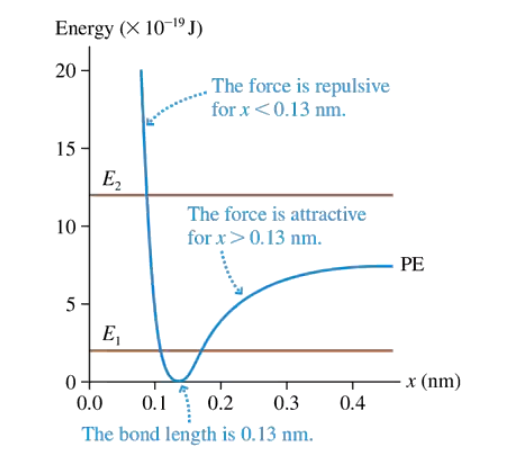
FIGURE 10.23 showed the potential-energy curve for the O2 molecule. Consider a molecule with the energy E1 shown in the figure. a. What is the maximum speed of an oxygen atom as it oscillates back and forth? Don't forget that the kinetic energy is the total kinetic energy of the system. The mass of an oxygen atom is 16 u, where 1u=1 atomic mass unit =1.66×10⁻²⁷ kg .

Verified step by step guidance
1
Identify the total energy of the system, E1, as given in the problem. The total energy is the sum of the potential energy (U) and the kinetic energy (K). At the turning points of the oscillation, the kinetic energy is zero, and the total energy is equal to the potential energy.
Determine the point on the potential-energy curve where the potential energy (U) is at its minimum. This corresponds to the equilibrium position of the molecule. At this point, the kinetic energy (K) is at its maximum because the total energy (E1) is constant.
Use the relationship between total energy, potential energy, and kinetic energy: \( K = E_1 - U \). At the equilibrium position, \( U \) is at its minimum, so \( K \) is maximized. Substitute the values of \( E_1 \) and \( U \) to find the maximum kinetic energy.
Relate the maximum kinetic energy to the speed of the oxygen atom using the formula for kinetic energy: \( K = \frac{1}{2} m v^2 \), where \( m \) is the mass of the oxygen atom and \( v \) is its speed. Solve for \( v \) using \( v = \sqrt{\frac{2K}{m}} \).
Substitute the given mass of the oxygen atom (16 u, where \( 1 \text{ u} = 1.66 \times 10^{-27} \text{ kg} \)) and the calculated maximum kinetic energy into the equation for \( v \) to find the maximum speed of the oxygen atom.

Verified video answer for a similar problem:

This video solution was recommended by our tutors as helpful for the problem above.
Video duration:
4m
Was this helpful?

Key Concepts

Here are the essential concepts you must grasp in order to answer the question correctly.

Potential Energy Curve

A potential energy curve represents the potential energy of a system as a function of the position of its components. In the context of molecular oscillations, it illustrates how the energy of a molecule changes as it moves between different positions, indicating stable and unstable configurations. The shape of the curve helps determine the energy states available to the molecule and is crucial for understanding oscillatory motion.
Recommended video:
Guided course
04:18
Curved Paths & Energy Conservation

Kinetic Energy

Kinetic energy is the energy possessed by an object due to its motion, calculated using the formula KE = 1/2 mv², where m is mass and v is velocity. In the context of oscillating molecules, the total kinetic energy of the system is related to the maximum speed of the atoms as they move back and forth. Understanding the relationship between kinetic and potential energy is essential for analyzing the motion of the molecule.
Recommended video:
Guided course
06:07
Intro to Rotational Kinetic Energy

Mass and Atomic Units

Mass in physics is a measure of the amount of matter in an object, typically expressed in kilograms. In this question, the mass of an oxygen atom is given in atomic mass units (u), where 1 u equals 1.66 × 10⁻²⁷ kg. Converting between these units is important for calculations involving kinetic energy and speed, as it allows for consistent application of physical formulas.
Recommended video:
Guided course
07:46
Unit Conversions
Related Practice
Textbook Question

A sled starts from rest at the top of the frictionless, hemispherical, snow-covered hill shown in FIGURE P10.56. a. Find an expression for the sled's speed when it is at angle ϕ .

368
views

Textbook Question

A 1.0 kg mass that can move along the x-axis experiences the potential energy U = (x²−x) J, where x is in m. The mass has velocity vx = 3.0 m/s at position x = 1.0 m. At what position has it slowed to 1.0 m/s?

1768
views
Textbook Question

A freight company uses a compressed spring to shoot 2.0 kg packages up a 1.0-m-high frictionless ramp into a truck, as FIGURE P10.52 shows. The spring constant is 500 N/m and the spring is compressed 30 cm. What is the speed of the package when it reaches the truck?

1952
views
Textbook Question

The spring shown in FIGURE P10.54 is compressed 50 cm and used to launch a 100 kg physics student. The track is frictionless until it starts up the incline. The student's coefficient of kinetic friction on the 30° incline is 0.15. What is the student's speed just after losing contact with the spring?

<Image>

2814
views
Textbook Question

CALC A 2.6 kg block is attached to a horizontal rope that exerts a variable force Fx = (20 − 5x) N, where x is in m. The coefficient of kinetic friction between the block and the floor is 0.25. Initially the block is at rest at x = 0 m. What is the block's speed when it has been pulled to x = 4.0 m?

3099
views
Textbook Question

The ice cube is replaced by a 50 g plastic cube whose coefficient of kinetic friction is 0.20. How far will the plastic cube travel up the slope? Use work and energy.

1979
views