


Ch 34: Geometric Optics
Young & Freedman Calc - University Physics 14th Edition
Young & Freedman Calc14th EditionUniversity PhysicsISBN: 9780321973610Not the one you use?Change textbook
Chapter 34, Problem 15a

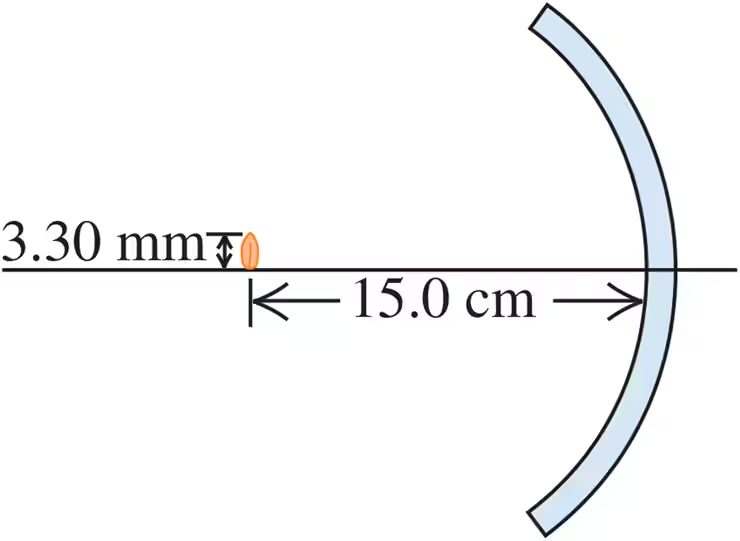
The thin glass shell shown in Fig. E34.15 has a spherical shape with a radius of curvature of 12.0 cm, and both of its surfaces can act as mirrors. A seed 3.30 mm high is placed 15.0 cm from the center of the mirror along the optic axis, as shown in the figure. Calculate the location and height of the of this seed.

Verified step by step guidance
1
Identify the type of mirror: The thin glass shell acts as a spherical mirror with a radius of curvature of 12.0 cm. Since the seed is placed outside the mirror, it is a convex mirror.
Use the mirror equation to find the image location: The mirror equation is \( \frac{1}{f} = \frac{1}{d_o} + \frac{1}{d_i} \), where \( f \) is the focal length, \( d_o \) is the object distance, and \( d_i \) is the image distance. For a convex mirror, the focal length \( f \) is negative and equal to half the radius of curvature, \( f = -\frac{R}{2} = -6.0 \text{ cm} \). The object distance \( d_o \) is 15.0 cm.
Calculate the image distance \( d_i \): Rearrange the mirror equation to solve for \( d_i \): \( \frac{1}{d_i} = \frac{1}{f} - \frac{1}{d_o} \). Substitute the values for \( f \) and \( d_o \) to find \( d_i \).
Determine the magnification \( m \): The magnification is given by \( m = -\frac{d_i}{d_o} \). Use the calculated \( d_i \) and given \( d_o \) to find \( m \).
Calculate the image height: The image height \( h_i \) is related to the object height \( h_o \) and magnification \( m \) by \( h_i = m \times h_o \). Given \( h_o = 3.30 \text{ mm} \), use the magnification to find \( h_i \).

Verified video answer for a similar problem:

This video solution was recommended by our tutors as helpful for the problem above.
Video duration:
3m
Was this helpful?

Key Concepts

Here are the essential concepts you must grasp in order to answer the question correctly.

Mirror Equation

The mirror equation relates the object distance (p), image distance (q), and focal length (f) of a spherical mirror: 1/f = 1/p + 1/q. This equation is essential for determining the position of the image formed by the mirror. In this problem, the radius of curvature is given, allowing us to find the focal length using f = R/2, where R is the radius of curvature.
Recommended video:
09:03
Mirror Equation

Magnification

Magnification (M) in mirrors is defined as the ratio of the image height (h') to the object height (h), given by M = h'/h = -q/p. This concept helps in calculating the size of the image formed by the mirror. The negative sign indicates that the image is inverted relative to the object. Understanding magnification is crucial for determining the height of the image in this scenario.
Recommended video:
09:03
Mirror Equation

Spherical Mirrors

Spherical mirrors, such as the one in the problem, can be concave or convex, affecting how they reflect light and form images. The curvature of the mirror influences the focal point and the nature of the image (real or virtual, inverted or upright). In this case, the thin glass shell acts as a spherical mirror, and its properties are used to analyze the image formation along the optic axis.
Recommended video:
05:51
Refraction at Spherical Surfaces
Related Practice
Textbook Question

Dental Mirror. A dentist uses a curved mirror to view teeth on the upper side of the mouth. Suppose she wants an erect with a magnification of 2.00 when the mirror is 1.25 cm from a tooth. (Treat this problem as though the object and lie along a straight line.) What must be the focal length and radius of curvature of this mirror?

2158
views
Textbook Question

A person is lying on a diving board 3.00 m above the surface of the water in a swimming pool. She looks at a penny that is on the bottom of the pool directly below her. To her, the penny appears to be a distance of 7.00 m from her. What is the depth of the water at this point?

1613
views
Textbook Question

The glass rod of Exercise 34.22 is immersed in oil (n = 1.45). An object placed to the left of the rod on the rod's axis is to be d 1.20 m inside the rod. How far from the left end of the rod must the object be located to form the image?

1611
views
Textbook Question

You hold a spherical salad bowl 60 cm in front of your face with the bottom of the bowl facing you. The bowl is made of polished metal with a 35-cm radius of curvature. Where is the of your 5.0-cm tall nose located?

1840
views
Textbook Question

A Spherical Fish Bowl. A small tropical fish is at the center of a water-filled, spherical fish bowl 28.0 cm in diameter. Find the apparent position and magnification of the fish to an observer outside the bowl. The effect of the thin walls of the bowl may be ignored.

2139
views
Textbook Question

A spherical, concave shaving mirror has a radius of curvature of 32.0 cm. Where is the image? Is the image real or virtual?

1858
views