
A very large, horizontal, nonconducting sheet of charge has uniform charge per unit area C/m2. A small sphere of mass kg and charge is placed cm above the sheet of charge and then released from rest. If the sphere is to remain motionless when it is released, what must be the value of ?
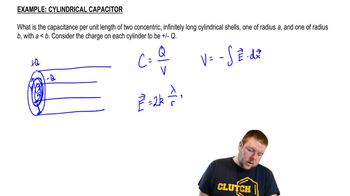
An infinitely long cylindrical conductor has radius and uniform surface charge density . In terms of and , what is the charge per unit length for the cylinder?
Verified step by step guidance
Verified video answer for a similar problem:
Key Concepts
Surface Charge Density
Charge per Unit Length
Cylindrical Geometry
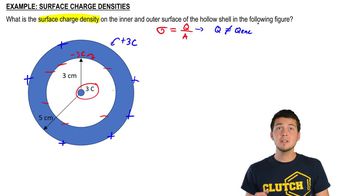
A conductor with an inner cavity, like that shown in Fig. c, carries a total charge of nC. The charge within the cavity, insulated from the conductor, is nC. How much charge is on (a) the inner surface of the conductor and (b) the outer surface of the conductor?
An infinitely long cylindrical conductor has radius and uniform surface charge density . In terms of , what is the magnitude of the electric field produced by the charged cylinder at a distance from its axis? Then, express the result in terms of and show that the electric field outside the cylinder is the same as if all the charge were on the axis.
A very large, horizontal, nonconducting sheet of charge has uniform charge per unit area C/m2. A small sphere of mass kg and charge is placed cm above the sheet of charge and then released from rest. What is if the sphere is released cm above the sheet?
A very long conducting tube (hollow cylinder) has inner radius and outer radius . It carries charge per unit length , where is a positive constant with units of C/m. A line of charge lies along the axis of the tube. The line of charge has charge per unit length. What is the charge per unit length on (i) the inner surface of the tube and (ii) the outer surface of the tube?
A very long conducting tube (hollow cylinder) has inner radius and outer radius . It carries charge per unit length , where is a positive constant with units of C/m. A line of charge lies along the axis of the tube. The line of charge has charge per unit length. Calculate the electric field in terms of and the distance from the axis of the tube for (i) ; (ii) ; (iii) . Show your results in a graph of as a function of .
