
Ch 12: Fluid Mechanics
Young & Freedman Calc - University Physics 14th Edition
Young & Freedman Calc14th EditionUniversity PhysicsISBN: 9780321973610Not the one you use?Change textbook
Chapter 12, Problem 50

A pressure difference of 6.00 × 10⁴ Pa is required to maintain a volume flow rate of 0.800m3/s for a viscous fluid flowing through a section of cylindrical pipe that has radius 0.210 m. What pressure difference is required to maintain the same volume flow rate if the radius of the pipe is decreased to 0.0700 m?

Verified step by step guidance
1
Identify the relationship between pressure difference, volume flow rate, and radius for a viscous fluid in a cylindrical pipe using Poiseuille's Law: \( Q = \frac{\pi \cdot \Delta P \cdot r^4}{8 \cdot \eta \cdot L} \), where \( Q \) is the volume flow rate, \( \Delta P \) is the pressure difference, \( r \) is the radius, \( \eta \) is the dynamic viscosity, and \( L \) is the length of the pipe.
Recognize that the volume flow rate \( Q \) and the dynamic viscosity \( \eta \) remain constant, and the length \( L \) of the pipe is unchanged. Therefore, the relationship between pressure difference and radius can be expressed as \( \Delta P_1 \cdot r_1^4 = \Delta P_2 \cdot r_2^4 \).
Substitute the known values into the equation: \( 6.00 \times 10^4 \text{ Pa} \cdot (0.210 \text{ m})^4 = \Delta P_2 \cdot (0.0700 \text{ m})^4 \).
Solve for the new pressure difference \( \Delta P_2 \) by rearranging the equation: \( \Delta P_2 = \frac{6.00 \times 10^4 \text{ Pa} \cdot (0.210 \text{ m})^4}{(0.0700 \text{ m})^4} \).
Calculate the value of \( \Delta P_2 \) using the given values to find the required pressure difference for the reduced radius.

Verified video answer for a similar problem:

This video solution was recommended by our tutors as helpful for the problem above.
Video duration:
2m
Was this helpful?

Key Concepts

Here are the essential concepts you must grasp in order to answer the question correctly.

Poiseuille's Law

Poiseuille's Law describes the volumetric flow rate of a viscous fluid through a cylindrical pipe. It states that the flow rate is directly proportional to the pressure difference and the fourth power of the pipe's radius, and inversely proportional to the fluid's viscosity and the pipe's length. This relationship highlights the significant impact of the pipe's radius on flow rate.
Recommended video:

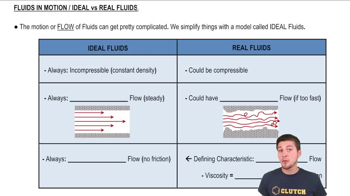
Viscosity

Viscosity is a measure of a fluid's resistance to deformation or flow. In the context of fluid dynamics, it quantifies the internal friction within the fluid, affecting how easily it can move through a pipe. Higher viscosity means greater resistance to flow, requiring a larger pressure difference to maintain the same flow rate.
Recommended video:
Guided course
03:41
Ideal vs Real Fluids

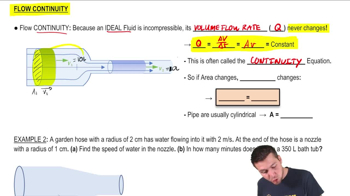
Continuity Equation

The Continuity Equation in fluid dynamics states that the mass flow rate must remain constant from one cross-section of a pipe to another, assuming incompressible flow. This principle implies that if the pipe's radius decreases, the fluid velocity must increase to maintain the same volume flow rate, affecting the required pressure difference.
Recommended video:
Guided course
11:08
Flow Continuity