
Ch 15: Mechanical Waves
Young & Freedman Calc - University Physics 14th Edition
Young & Freedman Calc14th EditionUniversity PhysicsISBN: 9780321973610Not the one you use?Change textbook
Chapter 15, Problem 46c

A horizontal string tied at both ends is vibrating in its fundamental mode. The traveling waves have speed vv, frequency ff, amplitude AA, and wavelength λ\(\lambda\). How much time does it take the string to go from its largest upward displacement to its largest downward displacement at the points located at (i) x=λ/2x = λ/2, (ii) x=λ/4x = λ/4, and (iii) x=λ/8x = λ/8, from the left-hand end of the string.

Verified step by step guidance
1
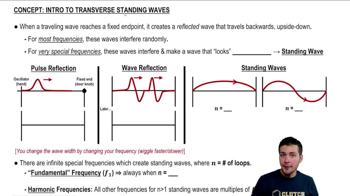
Understand that the string is vibrating in its fundamental mode, which means it forms a standing wave with nodes and antinodes. The fundamental frequency corresponds to the simplest pattern of vibration.
Recognize that the time taken for the string to move from its largest upward displacement to its largest downward displacement is half the period of the wave. The period T is the reciprocal of the frequency, given by T = 1/f.
Calculate the period of the wave using the formula T = 1/f. This period represents the time for one complete cycle of the wave.
For each point (x = λ/2, x = λ/4, x = λ/8), determine the position relative to the nodes and antinodes. At x = λ/2, the point is at an antinode, while at x = λ/4 and x = λ/8, the points are between nodes and antinodes.
Since the time to go from the largest upward displacement to the largest downward displacement is half the period, calculate this time as T/2 for each point. This time is the same for all points because the wave's frequency and period are uniform across the string.

Verified video answer for a similar problem:

This video solution was recommended by our tutors as helpful for the problem above.
Video duration:
7m
Was this helpful?

Key Concepts

Here are the essential concepts you must grasp in order to answer the question correctly.

Wave Motion

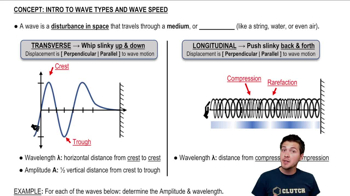
Wave motion refers to the transfer of energy through a medium via oscillations or vibrations. In the context of a vibrating string, waves travel along the string, characterized by parameters such as speed, frequency, amplitude, and wavelength. Understanding wave motion is crucial for analyzing how the string moves between its maximum displacements.
Recommended video:
Guided course
07:19
Intro to Waves and Wave Speed

Fundamental Mode of Vibration

The fundamental mode of vibration is the simplest form of oscillation for a system, where the entire string vibrates in a single segment between its fixed ends. This mode has the lowest frequency and longest wavelength, and it is essential for determining the behavior of the string at specific points, such as x = λ/2, λ/4, and λ/8.
Recommended video:
Guided course
07:58
Intro to Transverse Standing Waves

Wave Period and Frequency

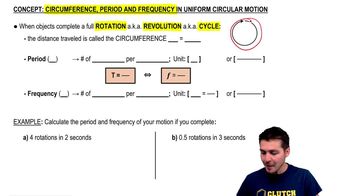
The period of a wave is the time it takes for one complete cycle of vibration, while frequency is the number of cycles per second. These concepts are inversely related and are crucial for calculating the time taken for the string to move from its largest upward to downward displacement, as the period determines the timing of oscillations at different points along the string.
Recommended video:
Guided course
05:08
Circumference, Period, and Frequency in UCM