Ch 04: Kinematics in Two Dimensions
Knight Calc - Physics for Scientists and Engineers 5th Edition
Knight Calc5th EditionPhysics for Scientists and EngineersISBN: 9780137344796Not the one you use?Change textbook
Chapter 4, Problem 75

A painted tooth on a spinning gear has angular position θ = (6.0 rad/s⁴)t⁴. What is the tooth's angular acceleration at the end of 10 revolutions?

Verified step by step guidance
1
Step 1: Understand the given angular position equation θ = (6.0 rad/s⁴)t⁴. Here, θ is the angular position as a function of time t, and the coefficient 6.0 rad/s⁴ represents the proportionality constant. Angular acceleration is the second derivative of angular position with respect to time.
Step 2: Differentiate θ with respect to time t to find the angular velocity ω. Using the formula ω = dθ/dt, calculate the first derivative of θ = (6.0 rad/s⁴)t⁴. This gives ω = 4(6.0 rad/s⁴)t³ = 24.0t³ rad/s.
Step 3: Differentiate ω with respect to time t to find the angular acceleration α. Using the formula α = dω/dt, calculate the second derivative of θ. This gives α = d(24.0t³)/dt = 72.0t² rad/s².
Step 4: Determine the time t corresponding to 10 revolutions. One revolution corresponds to an angular displacement of 2π radians. Therefore, 10 revolutions correspond to an angular displacement of θ = 10 × 2π = 20π radians. Solve for t in the equation θ = (6.0 rad/s⁴)t⁴ by substituting θ = 20π. This gives 20π = (6.0 rad/s⁴)t⁴. Solve for t.
Step 5: Substitute the value of t obtained in Step 4 into the angular acceleration formula α = 72.0t² rad/s² to find the angular acceleration at the end of 10 revolutions.

Verified video answer for a similar problem:

This video solution was recommended by our tutors as helpful for the problem above.
Video duration:
5m
Was this helpful?

Key Concepts

Here are the essential concepts you must grasp in order to answer the question correctly.

Angular Position

Angular position describes the orientation of a rotating object in terms of an angle, typically measured in radians. In this question, the angular position θ is given as a function of time, indicating how it changes as the gear spins. Understanding this concept is crucial for determining how the gear's rotation evolves over time.
Recommended video:
Guided course
14:03
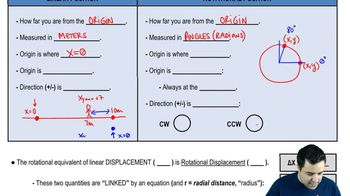
Rotational Position & Displacement

Angular Velocity

Angular velocity is the rate of change of angular position with respect to time, usually expressed in radians per second (rad/s). It can be derived from the angular position function by taking its first derivative. In this case, knowing the angular velocity at a specific time will help in calculating the angular acceleration.
Recommended video:
Guided course
06:18
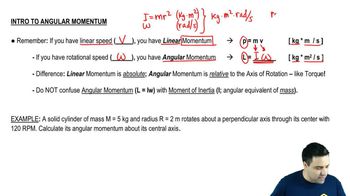
Intro to Angular Momentum

Angular Acceleration

Angular acceleration is the rate of change of angular velocity with respect to time, measured in radians per second squared (rad/s²). It can be found by taking the derivative of the angular velocity. In this problem, calculating the angular acceleration at the end of 10 revolutions requires understanding how the angular position function relates to both angular velocity and acceleration.
Recommended video:
Guided course
12:12
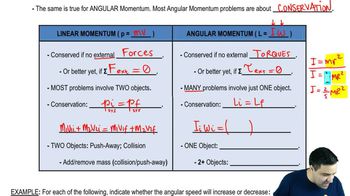
Conservation of Angular Momentum
Related Practice
Textbook Question

The cannon in FIGURE CP4.83 fires a projectile at launch angle θ with respect to the slope, which is at angle Φ. Find the launch angle that maximizes d. Hint: Choosing the proper coordinate system is essential. There are two options.

2058
views
Textbook Question

In Problems 78, 79, and 80 you are given the equations that are used to solve a problem. For each of these, you are to write a realistic problem for which these are the correct equations. Be sure that the answer your problem requests is consistent with the equations given.

100m=0m+(50cosθm/s)t10m=0m+(50sinθm/s)t112(9.80m/s2)t12\(\begin{aligned}\)100 \, \(\text{m}\) &= 0 \, \(\text{m}\) + (50 \(\cos\) \(\theta\) \, \(\text{m/s}\)) t_1 \\0 \, \(\text{m}\) &= 0 \, \(\text{m}\) + (50 \(\sin\) \(\theta\) \, \(\text{m/s}\)) t_1 - \(\frac{1}{2}\) (9.80 \, \(\text{m/s}\)^2) t_1^2\(\end{aligned}\)

422
views
Textbook Question

A 6.0-cm-diameter gear rotates with angular velocity ω = ( 20 ─ ½ t² ) rad/s where t is in seconds. At t = 4.0 s, what are: The tangential acceleration of a tooth on the gear?

1489
views
Textbook Question

An archer standing on a 15° slope shoots an arrow 20° above the horizontal, as shown in FIGURE CP4.82. How far down the slope does the arrow hit if it is shot with a speed of 5.0 m/s from 1.75 m above the ground?

299
views
Textbook Question

The angular velocity of a process control motor is ω = ( 20 ─ ½ t² ) rad/s, where t is in seconds. Through what angle does the motor turn between t = 0 s and the instant at which it reverses direction?

1908
views
Textbook Question

A 6.0-cm-diameter gear rotates with angular velocity ω = ( 20 ─ ½ t² ) rad/s where t is in seconds. At t = 4.0 s, what are: The gear's angular acceleration?

1494
views