
Ch 14: Fluids and Elasticity
Knight Calc - Physics for Scientists and Engineers 5th Edition
Knight Calc5th EditionPhysics for Scientists and EngineersISBN: 9780137344796Not the one you use?Change textbook
Chapter 14, Problem 32

An unknown liquid flows smoothly through a 6.0-mm-diameter horizontal tube where the pressure gradient is 600 Pa/m. Then the tube diameter gradually shrinks to 3.0 mm. What is the pressure gradient in this narrower portion of the tube?

Verified step by step guidance
1
Understand that this problem involves the principle of fluid dynamics, specifically the Hagen-Poiseuille equation, which relates the pressure gradient, flow rate, and tube dimensions for laminar flow. The equation is: Q=πΔPr48.
Recognize that the flow rate Q is constant throughout the tube because the liquid is incompressible. This means the pressure gradient in the narrower section must adjust to maintain the same flow rate.
Write the Hagen-Poiseuille equation for both sections of the tube. For the wider section: Q=πΔPr48. For the narrower section: Q=πΔPr48.
Set the flow rates equal to each other and solve for the pressure gradient in the narrower section. The relationship will be: ΔPΔP=r4r4.
Substitute the radii of the two sections (3.0 mm and 6.0 mm) into the equation to find the ratio of the pressure gradients. Multiply the given pressure gradient in the wider section (600 Pa/m) by this ratio to find the pressure gradient in the narrower section.

Verified video answer for a similar problem:

This video solution was recommended by our tutors as helpful for the problem above.
Video duration:
6m
Was this helpful?

Key Concepts

Here are the essential concepts you must grasp in order to answer the question correctly.

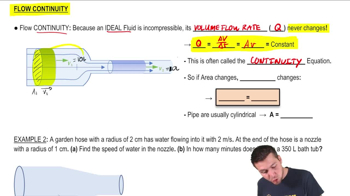
Continuity Equation

The Continuity Equation states that for an incompressible fluid flowing through a pipe, the mass flow rate must remain constant. This means that the product of the cross-sectional area and the fluid velocity is constant along the flow. As the diameter of the tube decreases, the velocity of the fluid must increase to maintain this constant flow rate.
Recommended video:
Guided course
11:08
Flow Continuity

Bernoulli's Principle

Bernoulli's Principle relates the pressure, velocity, and height of a fluid in steady flow. It states that an increase in the fluid's velocity occurs simultaneously with a decrease in pressure or potential energy. In the context of the tube, as the diameter decreases and the fluid velocity increases, the pressure in the narrower section will drop, which is crucial for calculating the new pressure gradient.
Recommended video:
Guided course
14:47
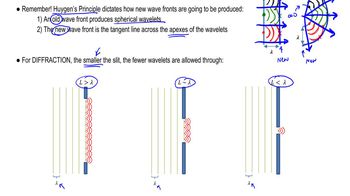
Diffraction with Huygen's Principle

Pressure Gradient

The pressure gradient is defined as the change in pressure per unit length of a fluid flow. It is a driving force for fluid movement, indicating how pressure varies along the flow direction. In this scenario, understanding how the pressure gradient changes when the tube diameter decreases is essential for determining the new pressure conditions in the narrower section of the tube.
Recommended video:
Guided course
17:04
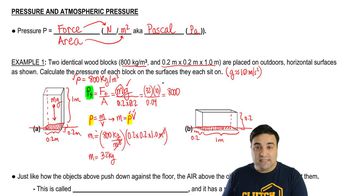
Pressure and Atmospheric Pressure
Related Practice
Textbook Question

A 2.0 mL syringe has an inner diameter of 6.0 mm, a needle inner diameter of 0.25 mm, and a plunger pad diameter (where you place your finger) of 1.2 cm. A nurse uses the syringe to inject medicine into a patient whose blood pressure is 140/100. The nurse empties the syringe in 2.0 s. What is the flow speed of the medicine through the needle?

1890
views
Textbook Question

A 5.0-m-diameter solid aluminum sphere is launched into space. By how much does its diameter increase? Give your answer in μm.

2074
views
Textbook Question

A friend asks you how much pressure is in your car tires. You know that the tire manufacturer recommends 30 psi, but it's been a while since you've checked. You can't find a tire gauge in the car, but you do find the owner's manual and a ruler. Fortunately, you've just finished taking physics, so you tell your friend, 'I don't know, but I can figure it out.' From the owner's manual you find that the car's mass is 1500 kg. It seems reasonable to assume that each tire supports one-fourth of the weight. With the ruler you find that the tires are 15 cm wide and the flattened segment of the tire in contact with the road is 13 cm long. What answer—in psi—will you give your friend?

2232
views
Textbook Question

What does the top pressure gauge read in FIGURE EX14.28?

2061
views
Textbook Question

A 2.0 mL syringe has an inner diameter of 6.0 mm, a needle inner diameter of 0.25 mm, and a plunger pad diameter (where you place your finger) of 1.2 cm. A nurse uses the syringe to inject medicine into a patient whose blood pressure is 140/100. What is the minimum force the nurse needs to apply to the syringe?

373
views
Textbook Question

When a second student joins the first, the piston sinks. What is the second student's mass?

1651
views