
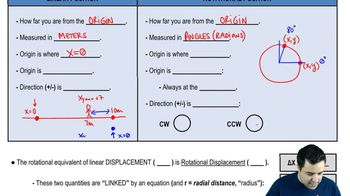
A wheel is rotating about an axis that is in the z-direction. The angular velocity ωz is -6.00 rad/s at t = 0, increases linearly with time, and is +4.00 rad/s at t = 7.00 s. We have taken counterclockwise rotation to be positive. What is the angular displacement of the wheel at t = 7.00 s?
A wheel is rotating about an axis that is in the z-direction. The angular velocity ωz is -6.00 rad/s at t = 0, increases linearly with time, and is +4.00 rad/s at t = 7.00 s. We have taken counterclockwise rotation to be positive. During what time interval is the speed of the wheel increasing? Decreasing?
Verified step by step guidance
Verified video answer for a similar problem:
Key Concepts
Angular Velocity
Angular Acceleration
Direction of Rotation
The angle θ through which a disk drive turns is given by θ(t) = a + bt - ct3, where a, b, and c are constants, t is in seconds, and θ is in radians. When t = 0, θ = π/4 rad and the angular velocity is 2.00 rad/s. When t = 1.50 s, the angular acceleration is 1.25 rad/s2. What are θ and the angular velocity when the angular acceleration is 3.50 rad/s2?
A bicycle wheel has an initial angular velocity of 1.50 rad/s. (a) If its angular acceleration is constant and equal to 0.200 rad/s2, what is its angular velocity at t = 2.50 s? (b) Through what angle has the wheel turned between t = 0 and t = 2.50 s?
A wheel is rotating about an axis that is in the z-direction. The angular velocity ωz is -6.00 rad/s at t = 0, increases linearly with time, and is +4.00 rad/s at t = 7.00 s. We have taken counterclockwise rotation to be positive. Is the angular acceleration during this time interval positive or negative?
An electric fan is turned off, and its angular velocity decreases uniformly from 500 rev/min to 200 rev/min in 4.00 s. Find the angular acceleration in rev/s2 and the number of revolutions made by the motor in the 4.00-s interval.
The angle θ through which a disk drive turns is given by θ(t) = a + bt - ct3, where a, b, and c are constants, t is in seconds, and θ is in radians. When t = 0, θ = π/4 rad and the angular velocity is 2.00 rad/s. When t = 1.50 s, the angular acceleration is 1.25 rad/s2. (b) What is the angular acceleration when θ = π/4 rad?
