Ch 02: Motion Along a Straight Line
Young & Freedman Calc - University Physics 14th Edition
Young & Freedman Calc14th EditionUniversity PhysicsISBN: 9780321973610Not the one you use?Change textbook
Chapter 2, Problem 48d

A large boulder is ejected vertically upward from a volcano with an initial speed of 40.040.0 m/s. Ignore air resistance. When is the velocity of the boulder zero?

Verified step by step guidance
1
Identify the type of motion: The boulder is undergoing vertical motion under the influence of gravity, which is a uniformly accelerated motion.
Understand that the velocity of the boulder will be zero at the peak of its trajectory. This is the point where the boulder stops ascending and is about to start descending.
Use the kinematic equation for velocity in uniformly accelerated motion: v=v0-gt, where v is the final velocity, v0 is the initial velocity, g is the acceleration due to gravity (approximately 9.8 m/s2), and t is the time.
Set the final velocity v to zero to find the time at which the velocity is zero: 0=40.0-9.8t.
Solve the equation for t to find the time at which the velocity is zero: t=40.09.8.

Verified video answer for a similar problem:

This video solution was recommended by our tutors as helpful for the problem above.
Video duration:
4m
Was this helpful?

Key Concepts

Here are the essential concepts you must grasp in order to answer the question correctly.

Projectile Motion

Projectile motion refers to the motion of an object thrown or projected into the air, subject to only the acceleration of gravity. In this scenario, the boulder is ejected vertically, and its motion can be analyzed using the principles of projectile motion, focusing on the vertical component.
Recommended video:
Guided course
04:44
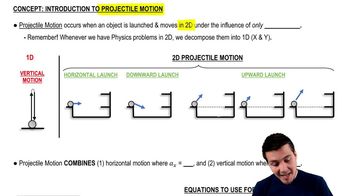
Introduction to Projectile Motion

Initial Velocity

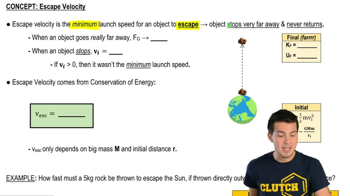
Initial velocity is the speed at which an object begins its motion. For the boulder, the initial velocity is 40.0 m/s upward. This value is crucial for calculating the time it takes for the boulder to reach its peak height, where its velocity becomes zero.
Recommended video:
Guided course
7:27
Escape Velocity

Acceleration due to Gravity

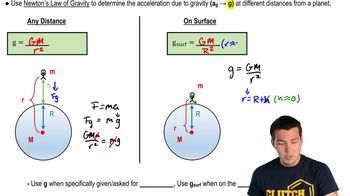
Acceleration due to gravity is the constant rate at which objects accelerate towards the Earth, approximately 9.8 m/s². It acts downward, opposing the boulder's upward motion, and determines how quickly the boulder slows down until its velocity reaches zero at the peak of its trajectory.
Recommended video:
Guided course
05:20
Acceleration Due to Gravity
Related Practice
Textbook Question

A large boulder is ejected vertically upward from a volcano with an initial speed of 40.040.0 m/s. Ignore air resistance. At what time after being ejected is the boulder moving at 20.020.0 m/s upward?

2187
views
Textbook Question

A rocket starts from rest and moves upward from the surface of the earth. For the first 10.010.0 s of its motion, the vertical acceleration of the rocket is given by ay=(2.80a_{y}=(2.80 m/s3)t)t, where the +y+y-direction is upward. What is the height of the rocket above the surface of the earth at t=10.0t = 10.0 s?

3288
views
Textbook Question

A large boulder is ejected vertically upward from a volcano with an initial speed of 40.040.0 m/s. Ignore air resistance. What are the magnitude and direction of the acceleration while the boulder is (i) moving upward? (ii) Moving downward? (iii) At the highest point?

1538
views
Textbook Question

A large boulder is ejected vertically upward from a volcano with an initial speed of 40.040.0 m/s. Ignore air resistance. At what time is it moving at 20.020.0 m/s downward?

1692
views
Textbook Question

A large boulder is ejected vertically upward from a volcano with an initial speed of 40.040.0 m/s. Ignore air resistance. When is the displacement of the boulder from its initial position zero?

1897
views
Textbook Question

You throw a small rock straight up from the edge of a highway bridge that crosses a river. The rock passes you on its way down, 6.006.00 s after it was thrown. What is the speed of the rock just before it reaches the water 28.028.0 m below the point where the rock left your hand? Ignore air resistance.

7112
views
2
comments