Ch 15: Oscillations
Knight Calc - Physics for Scientists and Engineers 5th Edition
Knight Calc5th EditionPhysics for Scientists and EngineersISBN: 9780137344796Not the one you use?Change textbook
Chapter 15, Problem 30

Astronauts on the first trip to Mars take along a pendulum that has a period on earth of 1.50 s. The period on Mars turns out to be 2.45 s. What is the free-fall acceleration on Mars?

Verified step by step guidance
1
Step 1: Recall the formula for the period of a pendulum: T = 2π√(L/g), where T is the period, L is the length of the pendulum, and g is the acceleration due to gravity.
Step 2: Rearrange the formula to solve for g: g = (4π²L)/T². This equation shows that g is inversely proportional to the square of the period.
Step 3: Since the pendulum's length L remains constant, use the ratio of the periods on Earth and Mars to find the ratio of the gravitational accelerations: g_{Mars}/g_{Earth} = (T_{Earth}/T_{Mars})².
Step 4: Substitute the given values for the periods: T_{Earth} = 1.50 \, s and T_{Mars} = 2.45 \, s. Calculate the ratio (T_{Earth}/T_{Mars})².
Step 5: Multiply the known value of Earth's gravitational acceleration, g_{Earth} = 9.8 \, m/s², by the calculated ratio to find g_{Mars}.

Verified video answer for a similar problem:

This video solution was recommended by our tutors as helpful for the problem above.
Video duration:
4m
Was this helpful?

Key Concepts

Here are the essential concepts you must grasp in order to answer the question correctly.

Pendulum Period

The period of a pendulum is the time it takes to complete one full oscillation. It is influenced by the length of the pendulum and the acceleration due to gravity. The formula for the period (T) of a simple pendulum is T = 2π√(L/g), where L is the length and g is the acceleration due to gravity. Understanding this relationship is crucial for analyzing how the period changes in different gravitational fields.
Recommended video:
Guided course
06:28
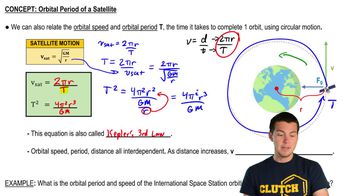
Satellite Period

Acceleration due to Gravity

Acceleration due to gravity (g) is the rate at which an object accelerates towards the center of a celestial body, such as Earth or Mars. On Earth, g is approximately 9.81 m/s², while on Mars, it is significantly lower, around 3.71 m/s². The difference in g affects the motion of objects, including pendulums, and is essential for calculating the gravitational force experienced by astronauts on Mars.
Recommended video:
Guided course
05:20
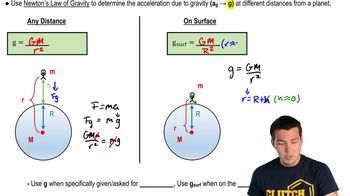
Acceleration Due to Gravity

Gravitational Comparison

When comparing gravitational effects on different planets, the change in the period of a pendulum can be used to derive the gravitational acceleration. By knowing the periods on Earth and Mars, one can set up a ratio based on the pendulum period formula to solve for the unknown gravitational acceleration on Mars. This concept illustrates how physical principles can be applied across different environments in space.
Recommended video:
Guided course
05:41
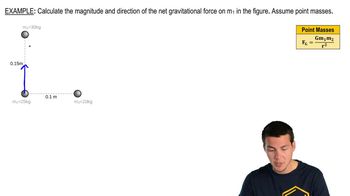
Gravitational Forces in 2D
Related Practice
Textbook Question

A pendulum is made by tying a 75 g ball to a 130-cm-long string. The ball is pulled 5.0° to the side and released. How many times does the ball pass through the lowest point of its arc in 7.5 s?

2555
views

Textbook Question

A spring is hung from the ceiling. When a block is attached to its end, it stretches 2.0 cm before reaching its new equilibrium length. The block is then pulled down slightly and released. What is the frequency of oscillation?

1942
views
Textbook Question

Vision is blurred if the head is vibrated at 29 Hz because the vibrations are resonant with the natural frequency of the eyeball in its socket. If the mass of the eyeball is 7.5 g, a typical value, what is the effective spring constant of the musculature that holds the eyeball in the socket?

1919
views
Textbook Question

A pendulum on a 75-cm-long string has a maximum speed of 0.25 m/s. What is the pendulum's maximum angle in degrees?

2234
views
Textbook Question

In a science museum, a 110 kg brass pendulum bob swings at the end of a 15.0-m-long wire. The pendulum is started at exactly 8:00 a.m. every morning by pulling it 1.5 m to the side and releasing it. Because of its compact shape and smooth surface, the pendulum's damping constant is only 0.010 kg/s. At exactly 12:00 noon, how many oscillations will the pendulum have completed and what is its amplitude?

1450
views
Textbook Question

The amplitude of an oscillator decreases to 36.8% of its initial value in 10.0 s. What is the value of the time constant?

1718
views