
Ch 18: Thermal Properties of Matter
Young & Freedman Calc - University Physics 14th Edition
Young & Freedman Calc14th EditionUniversity PhysicsISBN: 9780321973610Not the one you use?Change textbook
Chapter 18, Problem 43a

Solid water (ice) is slowly warmed from a very low temperature. What minimum external pressure p1p_1 must be applied to the solid if a melting phase transition is to be observed? Describe the sequence of phase transitions that occur if the applied pressure pp is such that p<p1p<p_1.

Verified step by step guidance
1
Understand the phase diagram of water: Water can exist in different phases (solid, liquid, gas) depending on temperature and pressure. The phase diagram shows the conditions under which each phase is stable.
Identify the melting point at standard pressure: At 1 atm pressure, ice melts at 0°C. However, the melting point can change with pressure.
Determine the pressure p1 for melting: The minimum external pressure p1 required for ice to melt can be found using the phase diagram. At pressures below p1, ice will not transition directly to liquid water upon heating.
Consider the sequence of phase transitions for p < p1: If the applied pressure is less than p1, ice will undergo sublimation, transitioning directly from solid to gas without passing through the liquid phase.
Use the Clausius-Clapeyron relation: This relation describes how the pressure and temperature at which phase transitions occur are related. It can be used to calculate the pressure p1 by considering the enthalpy and volume changes during the phase transition.

Verified video answer for a similar problem:

This video solution was recommended by our tutors as helpful for the problem above.
Video duration:
3m
Was this helpful?

Key Concepts

Here are the essential concepts you must grasp in order to answer the question correctly.

Phase Transitions

Phase transitions refer to the transformation of a substance from one state of matter to another, such as from solid to liquid. This process occurs when the temperature and pressure conditions reach specific thresholds, known as the melting point for solid to liquid transitions. Understanding these conditions is crucial for predicting the behavior of substances under varying external pressures.
Recommended video:
Guided course
08:59
Phase Constant of a Wave Function

Pressure and Melting Point

The melting point of a substance can be influenced by external pressure. For ice, increasing pressure can lower the melting point, allowing it to transition to liquid at lower temperatures. The minimum external pressure required to observe a melting phase transition is determined by the substance's phase diagram, which maps the relationship between pressure, temperature, and state of matter.
Recommended video:
Guided course
17:04
Pressure and Atmospheric Pressure

Phase Diagram

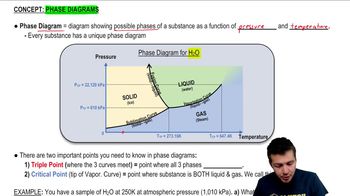
A phase diagram is a graphical representation that shows the conditions of temperature and pressure under which distinct phases of a substance exist. It helps in understanding the sequence of phase transitions, such as solid to liquid or liquid to gas, under varying pressures. For ice, the diagram indicates the pressure threshold p1 needed for melting, and the transitions that occur when p < p1.
Recommended video:
Guided course
06:59
Phase Diagrams