
Ch 20: The Micro/Macro Connection
Knight Calc - Physics for Scientists and Engineers 5th Edition
Knight Calc5th EditionPhysics for Scientists and EngineersISBN: 9780137344796Not the one you use?Change textbook
Chapter 20, Problem 19

By what factor does the rms speed of a molecule change if the temperature is increased from 10℃ to 1000℃?

Verified step by step guidance
1
Step 1: Understand the relationship between the root mean square (rms) speed of a molecule and temperature. The rms speed is given by the formula: 3kT, where k is the Boltzmann constant, T is the absolute temperature in Kelvin, and the factor of 3 comes from the degrees of freedom in the kinetic energy formula.
Step 2: Convert the given temperatures from Celsius to Kelvin. Use the formula: T=T+273.15. For 10℃, the temperature in Kelvin is 10+273.15. For 1000℃, the temperature in Kelvin is 1000+273.15.
Step 3: Recognize that the rms speed is proportional to the square root of the temperature. This means the factor by which the rms speed changes can be expressed as: TfinalTinitial, where Tfinal is the final temperature and Tinitial is the initial temperature.
Step 4: Substitute the values of Tfinal and Tinitial into the formula. For Tinitial, use the Kelvin temperature corresponding to 10℃, and for Tfinal, use the Kelvin temperature corresponding to 1000℃.
Step 5: Simplify the expression to find the factor by which the rms speed changes. This involves calculating the square root of the ratio of the final temperature to the initial temperature.

Verified video answer for a similar problem:

This video solution was recommended by our tutors as helpful for the problem above.
Video duration:
3m
Was this helpful?

Key Concepts

Here are the essential concepts you must grasp in order to answer the question correctly.

RMS Speed

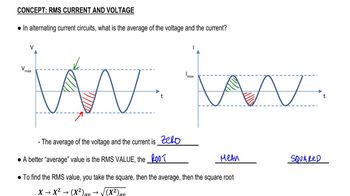
The root mean square (RMS) speed of gas molecules is a measure of the average speed of particles in a gas. It is calculated using the formula v_rms = √(3kT/m), where k is the Boltzmann constant, T is the absolute temperature in Kelvin, and m is the mass of a molecule. This concept is crucial for understanding how temperature affects molecular motion.
Recommended video:
Guided course
07:14
RMS Current and Voltage

Temperature and Kinetic Energy

Temperature is a measure of the average kinetic energy of the particles in a substance. As temperature increases, the kinetic energy of the molecules also increases, leading to higher speeds. This relationship is fundamental in thermodynamics and helps explain how changes in temperature influence molecular behavior.
Recommended video:
Guided course
06:07
Intro to Rotational Kinetic Energy

Absolute Temperature Scale

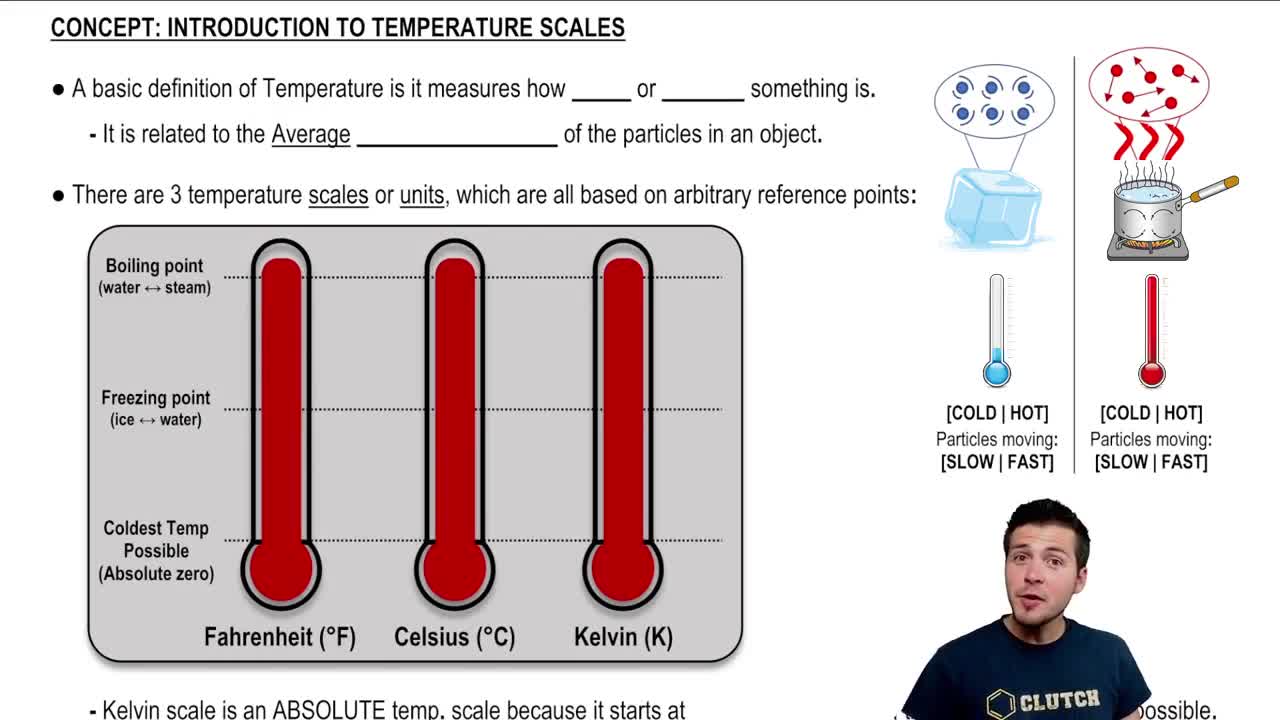
The absolute temperature scale, measured in Kelvin (K), is essential for calculations involving gas laws and molecular speeds. To convert Celsius to Kelvin, you add 273.15. Understanding this scale is necessary for accurately determining the RMS speed when temperatures are given in Celsius.
Recommended video:
Guided course
04:54
Introduction To Temperature Scales