Ch 42: Molecules and Condensed Matter
Young & Freedman Calc - University Physics 14th Edition
Young & Freedman Calc14th EditionUniversity PhysicsISBN: 9780321973610Not the one you use?Change textbook
Chapter 42, Problem 4a

During each of these processes, a photon of light is given up. In each process, what wavelength of light is given up, and in what part of the electromagnetic spectrum is that wavelength? A molecule decreases its vibrational energy by 0.1980.198 eV.

Verified step by step guidance
1
Step 1: Understand the relationship between energy and wavelength using the equation \( E = \frac{hc}{\lambda} \), where \( E \) is the energy of the photon, \( h \) is Planck's constant (\( 6.626 \times 10^{-34} \, \text{J·s} \)), \( c \) is the speed of light (\( 3.00 \times 10^8 \, \text{m/s} \)), and \( \lambda \) is the wavelength.
Step 2: Convert the energy given in electron volts (eV) to joules (J). Use the conversion factor \( 1 \text{ eV} = 1.602 \times 10^{-19} \, \text{J} \). Multiply \( 0.198 \, \text{eV} \) by \( 1.602 \times 10^{-19} \, \text{J/eV} \) to find the energy in joules.
Step 3: Rearrange the equation \( E = \frac{hc}{\lambda} \) to solve for wavelength \( \lambda \): \( \lambda = \frac{hc}{E} \). Substitute the values for \( h \), \( c \), and the energy \( E \) (converted to joules) into the equation.
Step 4: Calculate the wavelength \( \lambda \) in meters. If needed, convert the result to nanometers (nm) by multiplying the value in meters by \( 10^9 \).
Step 5: Determine the part of the electromagnetic spectrum the wavelength belongs to by comparing the calculated wavelength to the ranges of the spectrum (e.g., infrared, visible, ultraviolet). For reference, visible light ranges from approximately 400 nm to 700 nm, while infrared is longer than 700 nm.

Verified video answer for a similar problem:

This video solution was recommended by our tutors as helpful for the problem above.
Video duration:
3m
Was this helpful?

Key Concepts

Here are the essential concepts you must grasp in order to answer the question correctly.

Photon Energy and Wavelength

The energy of a photon is inversely related to its wavelength, described by the equation E = hc/λ, where E is energy, h is Planck's constant, c is the speed of light, and λ is the wavelength. A decrease in vibrational energy of a molecule corresponds to the emission of a photon with a specific wavelength, which can be calculated using this relationship.
Recommended video:
Guided course
05:42
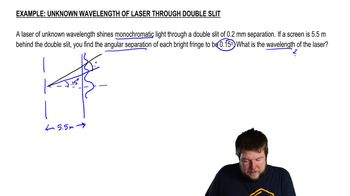
Unknown Wavelength of Laser through Double Slit

Electromagnetic Spectrum

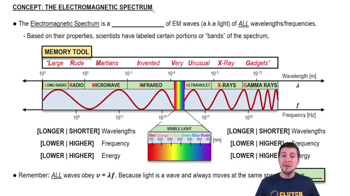
The electromagnetic spectrum encompasses all types of electromagnetic radiation, ranging from radio waves to gamma rays. Each type of radiation is characterized by its wavelength and frequency. The visible spectrum, which is a small part of the electromagnetic spectrum, includes wavelengths from approximately 400 nm (violet) to 700 nm (red).
Recommended video:
Guided course
06:06
The Electromagnetic Spectrum

Energy Units and Conversion

Energy in physics is often measured in electronvolts (eV), a unit commonly used in atomic and particle physics. To find the corresponding wavelength of light emitted when a molecule loses energy, one must convert the energy from eV to joules (1 eV = 1.602 x 10^-19 joules) and then use the photon energy-wavelength relationship to determine the wavelength in meters or nanometers.
Recommended video:
Guided course
07:46
Unit Conversions