
Textbook Question
A sophomore with nothing better to do adds heat to kg of ice at °C until it is all melted. What is the change in entropy of the water?
2052
views

 Verified step by step guidance
 08:45
08:45
 05:14
05:14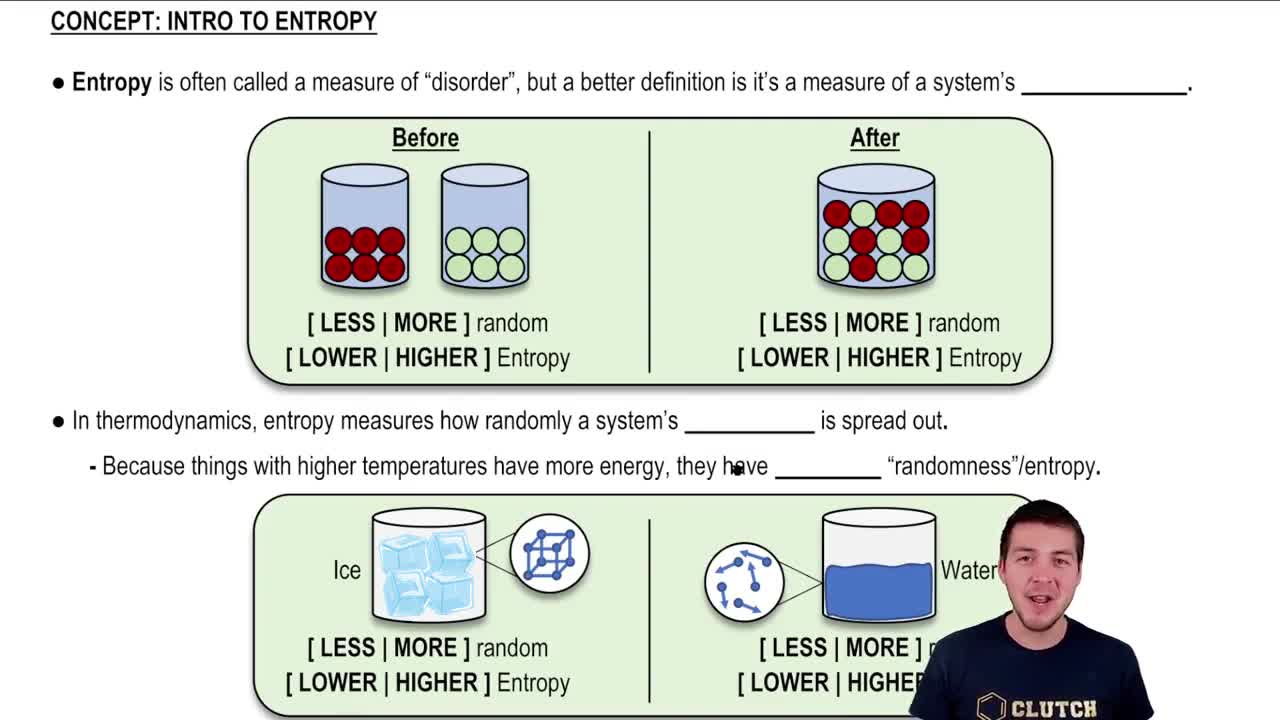 07:50
07:50A sophomore with nothing better to do adds heat to kg of ice at °C until it is all melted. What is the change in entropy of the water?
Two moles of an ideal gas occupy a volume . The gas expands isothermally and reversibly to a volume . Is the velocity distribution changed by the isothermal expansion? Explain.
You make tea with kg of °C water and let it cool to room temperature (°C). Calculate the entropy change of the water while it cools.
A -kg block of ice at °C melts to liquid water at °C inside a large room at °C. Treat the ice and the room as an isolated system, and assume that the room is large enough for its temperature change to be ignored. Is the melting of the ice reversible or irreversible? Explain, using simple physical reasoning without resorting to any equations.
A Carnot heat engine uses a hot reservoir consisting of a large amount of boiling water and a cold reservoir consisting of a large tub of ice and water. In minutes of operation, the heat rejected by the engine melts kg of ice. During this time, how much work is performed by the engine?
A -kg block of ice at °C falls into the ocean and melts. The average temperature of the ocean is °C, including all the deep water. By how much does the change of this ice to water at °C alter the entropy of the world? Does the entropy increase or decrease? (Hint: Do you think that the ocean temperature will change appreciably as the ice melts?)