
Ch 04: Kinematics in Two Dimensions
Knight Calc - Physics for Scientists and Engineers 5th Edition
Knight Calc5th EditionPhysics for Scientists and EngineersISBN: 9780137344796Not the one you use?Change textbook
Chapter 4, Problem 61

While driving north at 25 m/s during a rainstorm you notice that the rain makes an angle of 38° with the vertical. While driving back home moments later at the same speed but in the opposite direction, you see that the rain is falling straight down. From these observations, determine the speed and angle of the raindrops relative to the ground.

Verified step by step guidance
1
Identify the reference frames: The car is moving north at 25 m/s in the first observation and south at 25 m/s in the second observation. The rain's motion relative to the car is observed in both cases, and we need to determine the rain's velocity relative to the ground.
Analyze the first observation: When driving north at 25 m/s, the rain appears to make an angle of 38° with the vertical. This means the horizontal component of the rain's velocity relative to the car is responsible for this angle. Use the relationship \( \tan(\theta) = \frac{v_{\text{horizontal}}}{v_{\text{vertical}}} \), where \( \theta = 38° \).
Set up the equations for the first observation: Let \( v_{\text{horizontal}} \) and \( v_{\text{vertical}} \) be the horizontal and vertical components of the rain's velocity relative to the ground. The horizontal velocity of the rain relative to the car is \( v_{\text{horizontal}} - 25 \), and \( \tan(38°) = \frac{v_{\text{horizontal}} - 25}{v_{\text{vertical}}} \).
Analyze the second observation: When driving south at 25 m/s, the rain appears to fall straight down. This means the horizontal velocity of the rain relative to the car is zero. Therefore, \( v_{\text{horizontal}} + 25 = 0 \), which gives \( v_{\text{horizontal}} = -25 \, \text{m/s} \).
Combine the results: Substitute \( v_{\text{horizontal}} = -25 \, \text{m/s} \) into the equation from the first observation to solve for \( v_{\text{vertical}} \). Then, use the Pythagorean theorem \( v_{\text{rain}} = \sqrt{v_{\text{horizontal}}^2 + v_{\text{vertical}}^2} \) to find the magnitude of the rain's velocity relative to the ground, and use \( \tan^{-1}(\frac{v_{\text{vertical}}}{|v_{\text{horizontal}}|}) \) to find the angle of the rain relative to the ground.

Verified video answer for a similar problem:

This video solution was recommended by our tutors as helpful for the problem above.
Video duration:
18m
Was this helpful?

Key Concepts

Here are the essential concepts you must grasp in order to answer the question correctly.

Relative Velocity

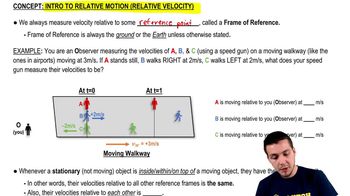
Relative velocity is the velocity of an object as observed from a particular reference frame. In this scenario, the speed of the car affects how the rain appears to fall. When the car moves north, the rain appears to come at an angle due to the combination of the car's velocity and the rain's velocity, which must be analyzed to find the actual speed and direction of the rain.
Recommended video:
Guided course
04:27
Intro to Relative Motion (Relative Velocity)

Vector Components

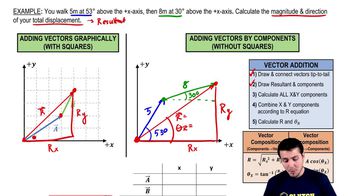
Vectors have both magnitude and direction, and they can be broken down into components along the axes of a coordinate system. In this problem, the rain's velocity can be decomposed into horizontal and vertical components. By analyzing these components when the car is moving in different directions, we can determine the actual velocity of the rain relative to the ground.
Recommended video:
Guided course
07:30
Vector Addition By Components

Trigonometric Relationships

Trigonometric functions relate the angles and sides of triangles, which are essential for solving problems involving angles and distances. In this case, the angle at which the rain falls can be analyzed using trigonometric ratios, such as sine and cosine, to find the vertical and horizontal components of the rain's velocity. This allows us to calculate the speed and direction of the rain relative to the ground.
Recommended video:
Guided course
3:26
Trigonometry