Ch 02: Kinematics in One Dimension
Knight Calc - Physics for Scientists and Engineers 5th Edition
Knight Calc5th EditionPhysics for Scientists and EngineersISBN: 9780137344796Not the one you use?Change textbook
Chapter 2, Problem 33a

A particle moving along the x-axis has its position described by the function x = (2t3 + 2t + 1) m, where t is in s. At t = 2s, what are the particle's position?

Verified step by step guidance
1
Step 1: Identify the given position function of the particle, which is x(t) = 2t^3 + 2t + 1 (in meters), where t is in seconds.
Step 2: To find the position of the particle at t = 2s, substitute t = 2 into the position function x(t). This means you will calculate x(2) = 2(2)^3 + 2(2) + 1.
Step 3: Simplify the expression by evaluating the powers and performing the arithmetic operations. Start with the cubic term, then the linear term, and finally add the constant term.
Step 4: After simplifying, the result will give you the position of the particle in meters at t = 2s.
Step 5: Ensure the units are consistent and the final position is expressed in meters, as the problem specifies the position in meters.

Verified video answer for a similar problem:

This video solution was recommended by our tutors as helpful for the problem above.
Video duration:
2m
Was this helpful?

Key Concepts

Here are the essential concepts you must grasp in order to answer the question correctly.

Position Function

The position function describes the location of a particle along a specific axis as a function of time. In this case, the position is given by the equation x = (2t^3 + 2t + 1) m, where 't' represents time in seconds. Understanding this function is crucial for determining the particle's position at any given time.
Recommended video:
Guided course
08:30
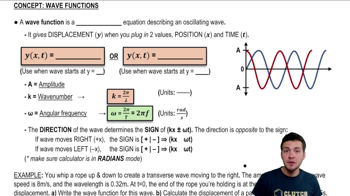
Intro to Wave Functions

Evaluating Functions

Evaluating a function involves substituting a specific value for the variable to find the corresponding output. For the position function x(t), substituting t = 2 seconds allows us to calculate the exact position of the particle at that moment. This process is fundamental in physics for analyzing motion.
Recommended video:
Guided course
08:30
Intro to Wave Functions

Kinematics

Kinematics is the branch of physics that deals with the motion of objects without considering the forces that cause the motion. It involves concepts such as position, velocity, and acceleration. In this question, understanding kinematics helps in interpreting the position function and its implications for the particle's movement along the x-axis.
Recommended video:
Guided course
08:25
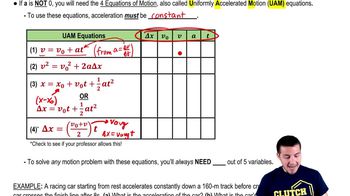
Kinematics Equations