Ch 02: Kinematics in One Dimension
Knight Calc - Physics for Scientists and Engineers 5th Edition
Knight Calc5th EditionPhysics for Scientists and EngineersISBN: 9780137344796Not the one you use?Change textbook
Chapter 2, Problem 84a

A rubber ball is shot straight up from the ground with speed v₀. Simultaneously, a second rubber ball at height h directly above the first ball is dropped from rest. At what height above the ground do the balls collide? Your answer will be an algebraic expression in terms of h, v₀, and g.

Verified step by step guidance
1
Define the motion equations for both balls. For the first ball (moving upward with initial velocity v₀), its height as a function of time t is given by: y1=v0t-12gt2. For the second ball (dropped from height h), its height as a function of time t is: y2=h-12gt2.
Set the heights of the two balls equal to each other to find the time t at which they collide: v0t-12gt2=h-12gt2.
Simplify the equation by canceling out the common term 12gt2 on both sides. This leaves: v0t=h.
Solve for the time t at which the collision occurs: t=hv0.
Substitute the value of t back into the height equation for either ball to find the height of collision. Using the first ball's equation: y=v0hv0-12ghv02. Simplify this expression to get the final algebraic expression for the height of collision.

Verified video answer for a similar problem:

This video solution was recommended by our tutors as helpful for the problem above.
Video duration:
12m
Was this helpful?

Key Concepts

Here are the essential concepts you must grasp in order to answer the question correctly.

Kinematics

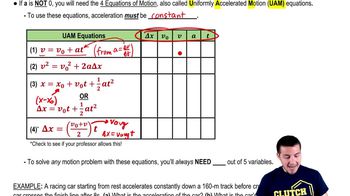
Kinematics is the branch of physics that describes the motion of objects without considering the forces that cause the motion. It involves concepts such as displacement, velocity, and acceleration. In this problem, kinematic equations will be used to determine the positions of both balls as functions of time, which is essential for finding the collision height.
Recommended video:
Guided course
08:25
Kinematics Equations

Acceleration due to Gravity (g)

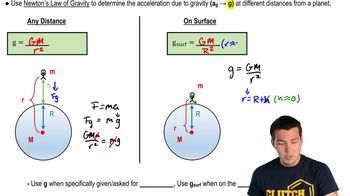
Acceleration due to gravity, denoted as g, is the acceleration experienced by an object due to the gravitational force exerted by the Earth. Near the Earth's surface, g is approximately 9.81 m/s² and acts downward. This constant will affect the motion of both balls, influencing their velocities and positions over time.
Recommended video:
Guided course
05:20
Acceleration Due to Gravity

Relative Motion

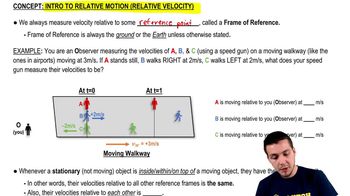
Relative motion refers to the calculation of the motion of an object as observed from another moving object. In this scenario, the motion of the two balls must be analyzed relative to each other to determine the point at which they collide. Understanding how their velocities and positions change over time is crucial for solving the problem.
Recommended video:
Guided course
04:27
Intro to Relative Motion (Relative Velocity)
Related Practice
Textbook Question

A sprinter can accelerate with constant acceleration for 4.0 s before reaching top speed. He can run the 100 meter dash in 10.0 s. What is his speed as he crosses the finish line?

2450
views

Textbook Question

A rubber ball is shot straight up from the ground with speed v0. Simultaneously, a second rubber ball at height h directly above the first ball is dropped from rest. What is the maximum value of h for which a collision occurs before the first ball falls back to the ground?

1841
views
Textbook Question

A good model for the acceleration of a car trying to reach top speed in the least amount of time is a𝓍 = a ─ kv𝓍, where a is the initial acceleration and k is a constant. Find an expression for the car's velocity as a function of time.

1938
views
Textbook Question

Careful measurements have been made of Olympic sprinters in the 100 meter dash. A quite realistic model is that the sprinter's velocity is given by v𝓍 = a ( 1 - e⁻ᵇᵗ ) where t is in s, v𝓍 is in m/s, and the constants a and b are characteristic of the sprinter. Sprinter Carl Lewis's run at the 1987 World Championships is modeled with a = 11.81 m/s and b = 0.6887 s⁻¹. Find an expression for the distance traveled at time t.

427
views
Textbook Question

A rubber ball is shot straight up from the ground with speed v₀. Simultaneously, a second rubber ball at height h directly above the first ball is dropped from rest. For what value of h does the collision occur at the instant when the first ball is at its highest point?

1878
views
1
rank