
Ch 11: Equilibrium & Elasticity
Young & Freedman Calc - University Physics 14th Edition
Young & Freedman Calc14th EditionUniversity PhysicsISBN: 9780321973610Not the one you use?Change textbook
Chapter 11, Problem 32c

A solid gold bar is pulled up from the hold of the sunken RMS Titanic. The bulk modulus of lead is one-fourth that of gold. Find the ratio of the volume change of a solid lead bar to that of a gold bar of equal volume for the same pressure change.

Verified step by step guidance
1
Understand the concept of bulk modulus, which is a measure of a material's resistance to uniform compression. It is defined as the ratio of the pressure change to the relative volume change: \( B = -\frac{\Delta P}{\frac{\Delta V}{V}} \).
Recognize that the problem involves comparing the volume change of two materials, lead and gold, under the same pressure change. The bulk modulus of lead is given as one-fourth that of gold.
Express the bulk modulus of lead \( B_{\text{lead}} \) in terms of the bulk modulus of gold \( B_{\text{gold}} \): \( B_{\text{lead}} = \frac{1}{4} B_{\text{gold}} \).
Use the formula for bulk modulus to express the volume change for each material. For gold, \( \Delta V_{\text{gold}} = -\frac{\Delta P \cdot V}{B_{\text{gold}}} \) and for lead, \( \Delta V_{\text{lead}} = -\frac{\Delta P \cdot V}{B_{\text{lead}}} \).
Substitute \( B_{\text{lead}} = \frac{1}{4} B_{\text{gold}} \) into the expression for \( \Delta V_{\text{lead}} \) and find the ratio \( \frac{\Delta V_{\text{lead}}}{\Delta V_{\text{gold}}} \). Simplify the expression to find the ratio of the volume change of lead to that of gold.

Verified video answer for a similar problem:

This video solution was recommended by our tutors as helpful for the problem above.
Video duration:
2m
Was this helpful?

Key Concepts

Here are the essential concepts you must grasp in order to answer the question correctly.

Bulk Modulus

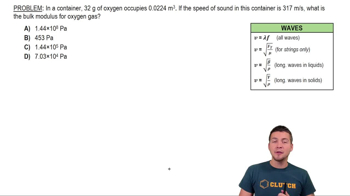
Bulk modulus is a measure of a material's resistance to uniform compression. It is defined as the ratio of pressure increase to the relative decrease in volume. A higher bulk modulus indicates that a material is less compressible. In this problem, understanding the bulk modulus helps compare how lead and gold respond to pressure changes.
Recommended video:

Volume Change Under Pressure

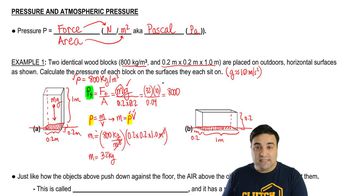
Volume change under pressure refers to how the volume of a material changes when subjected to external pressure. This concept is crucial for determining how different materials, like lead and gold, will compress under the same pressure. The relationship between pressure, bulk modulus, and volume change is key to solving the problem.
Recommended video:
Guided course
17:04
Pressure and Atmospheric Pressure

Ratio of Volume Change

The ratio of volume change compares the extent to which two materials change in volume under identical pressure conditions. Given that lead's bulk modulus is one-fourth that of gold, this concept helps calculate how much more lead will compress compared to gold, using the inverse relationship between bulk modulus and volume change.
Recommended video:
Guided course
05:21
Volume Thermal Expansion
Related Practice
Textbook Question

Two circular rods, one steel and the other copper, are joined end to end. Each rod is 0.750 m long and 1.50 cm in diameter. The combination is subjected to a tensile force with magnitude 4000 N. For each rod, what are (a) the strain and (b) the elongation?

1745
views
Textbook Question

In the Challenger Deep of the Marianas Trench, the depth of seawater is 10.9 km and the pressure is 1.16×10⁸ Pa (about 1.15×10³ atm). If a cubic meter of water is taken from the surface to this depth, what is the change in its volume? (Normal atmospheric pressure is about 1.0×10⁵ Pa. Assume that k for seawater is the same as the freshwater value given in Table 11.2.)

3273
views
Textbook Question

A square steel plate is 10.0 cm on a side and 0.500 cm thick. (a) Find the shear strain that results if a force of magnitude 9.0×10⁵ N is applied to each of the four sides, parallel to the side. (b) Find the displacement x (in centimeters).

2623
views
Textbook Question

A circular steel wire 2.00 m long must stretch no more than 0.25 cm when a tensile force of 700 N is applied to each end of the wire. What minimum diameter is required for the wire?

2838
views
Textbook Question

A specimen of oil having an initial volume of 600 cm3 is subjected to a pressure increase of 3.6×10⁶ Pa, and the volume is found to decrease by 0.45 cm3. What is the bulk modulus of the material and the compressibility?

2909
views
Textbook Question

A nylon rope used by mountaineers elongates 1.10 m under the weight of a 65.0 kg climber. If the rope is 45.0 m in length and 7.0 mm in diameter, what is Young's modulus for nylon?

1974
views