CALC The potential energy for a particle that can move along the x-axis is U = Ax2 + B sin(πx/L), where A, B, and L are constants. What is the force on the particle at (a) x = 0, (b) x = L/2, and (c) x = L?
Ch 10: Interactions and Potential Energy
Knight Calc5th EditionPhysics for Scientists and EngineersISBN: 9780137344796Not the one you use?Change textbook
Chapter 10, Problem 71
In a physics lab experiment, a compressed spring launches a 20 g metal ball at a 30° angle. Compressing the spring 20 cm causes the ball to hit the floor 1.5 m below the point at which it leaves the spring after traveling 5.0 m horizontally. What is the spring constant?
Verified step by step guidance1
Convert all given quantities to SI units: the mass of the ball is \( m = 0.020 \; \text{kg} \), the spring compression is \( x = 0.20 \; \text{m} \), the horizontal distance is \( R = 5.0 \; \text{m} \), and the vertical displacement is \( \Delta y = -1.5 \; \text{m} \).
Use the horizontal motion equation \( R = v_x t \) to express the time of flight \( t \) in terms of the horizontal velocity \( v_x = v \cos \theta \), where \( v \) is the initial velocity and \( \theta = 30^\circ \). Rearrange to find \( t = \frac{R}{v \cos \theta} \).
Use the vertical motion equation \( \Delta y = v_y t - \frac{1}{2} g t^2 \), where \( v_y = v \sin \theta \) is the vertical velocity. Substitute \( t = \frac{R}{v \cos \theta} \) into this equation to solve for \( v \), the initial velocity.
Relate the initial velocity \( v \) to the spring's potential energy using the conservation of energy principle: \( \frac{1}{2} k x^2 = \frac{1}{2} m v^2 \), where \( k \) is the spring constant. Rearrange this equation to solve for \( k \): \( k = \frac{m v^2}{x^2} \).
Substitute the value of \( v \) obtained from the kinematic equations and the given quantities into the expression for \( k \) to calculate the spring constant.

Verified video answer for a similar problem:
This video solution was recommended by our tutors as helpful for the problem above.
Video duration:
15mWas this helpful?
Key Concepts
Here are the essential concepts you must grasp in order to answer the question correctly.
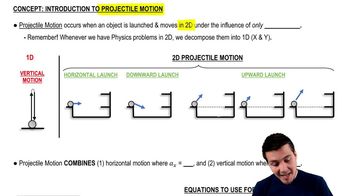
Projectile Motion
Projectile motion refers to the motion of an object that is launched into the air and is subject to gravitational forces. It can be analyzed in two dimensions: horizontal and vertical. The horizontal motion is uniform, while the vertical motion is influenced by gravity, leading to a parabolic trajectory. Understanding the components of projectile motion is essential for determining the range and height of the launched object.
Recommended video:
Guided course
Introduction to Projectile Motion
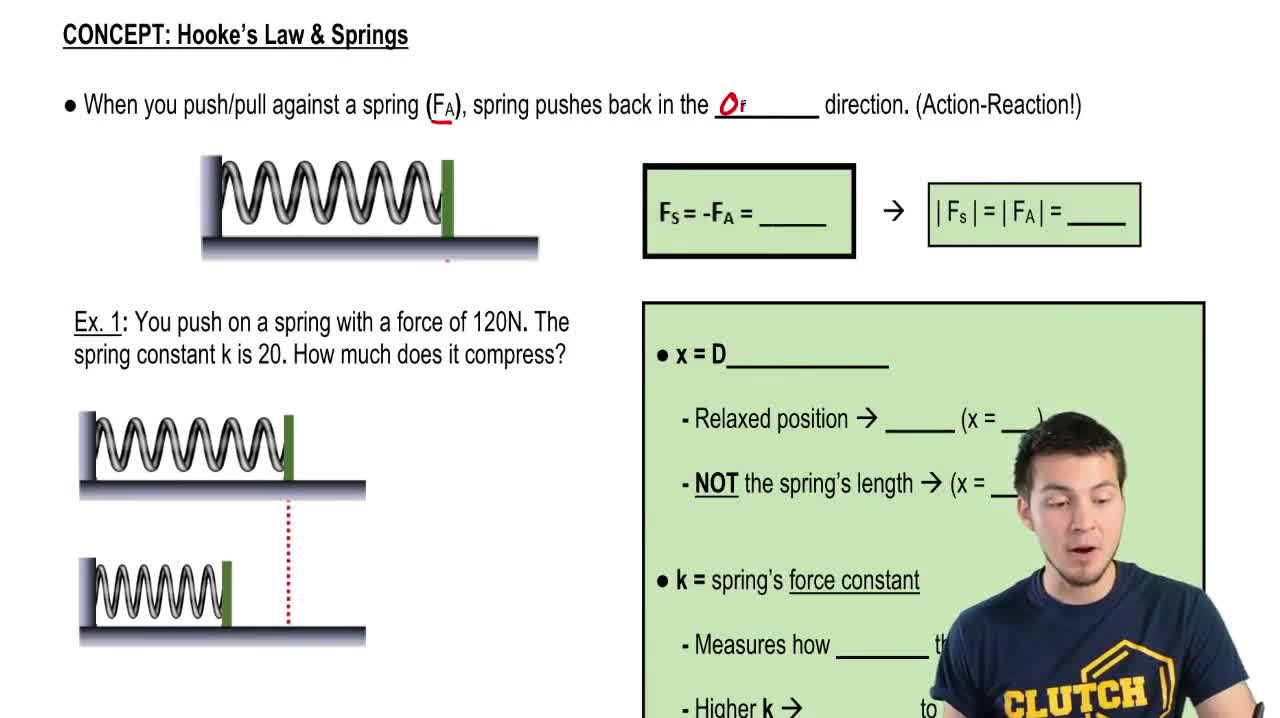
Spring Constant (Hooke's Law)
The spring constant, denoted as 'k', is a measure of a spring's stiffness and is defined by Hooke's Law, which states that the force exerted by a spring is proportional to its displacement from the equilibrium position. Mathematically, F = -kx, where F is the force, k is the spring constant, and x is the displacement. This concept is crucial for calculating the potential energy stored in a compressed spring, which is converted into kinetic energy when the spring is released.
Recommended video:
Guided course
Spring Force (Hooke's Law)
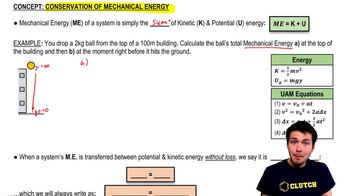
Energy Conservation
The principle of energy conservation states that energy cannot be created or destroyed, only transformed from one form to another. In the context of the spring and the ball, the potential energy stored in the compressed spring is converted into kinetic energy as the ball is launched. Additionally, the ball's kinetic energy is transformed into gravitational potential energy as it rises and then back into kinetic energy as it falls, which is vital for solving the problem of finding the spring constant.
Recommended video:
Guided course
Conservation Of Mechanical Energy
Related Practice
Textbook Question
2200
views
Textbook Question
A 10 kg box slides 4.0 m down the frictionless ramp shown in FIGURE CP10.73, then collides with a spring whose spring constant is 250 N/m. What is the maximum compression of the spring?
2765
views
1
rank
Textbook Question
CALC An object moving in the xy-plane is subjected to the force , where x and y are in m. Is this a conservative force?
2112
views
Textbook Question
CALC An object moving in the xy-plane is subjected to the force , where x and y are in m. The particle moves from the origin to the point with coordinates (a, b) by moving first along the x-axis to (a, 0), then parallel to the y-axis. How much work does the force do?
2458
views