
Textbook Question
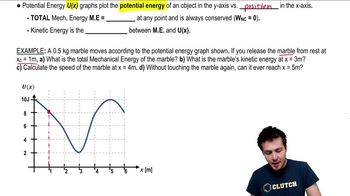
FIGURE EX10.28 shows the potential-energy diagram for a 500 g particle as it moves along the x-axis. Suppose the particle's mechanical energy is 12 J. Where are the particle's turning points?
2529
views

 Verified step by step guidance
 07:24
07:24
 03:43
03:43 02:34
02:34FIGURE EX10.28 shows the potential-energy diagram for a 500 g particle as it moves along the x-axis. Suppose the particle's mechanical energy is 12 J. Where are the particle's turning points?
A particle moves from A to D in FIGURE EX10.36 while experiencing force F = (6i + 8j) N. How much work does the force do if the particle follows path ACD. Is this a conservative force? Explain.
A system in which only one particle moves has the potential energy shown in FIGURE EX10.31. What is the x-component of the force on the particle at x = 5, 15, and 25 cm?
A particle moving along the x-axis is in a system that has potential energy U = x3 - 3x J, where x is in m. For each, is it a point of stable or unstable equilibrium?
In FIGURE EX10.28, what is the maximum speed a 200 g particle could have at x = 2.0 m and never reach x = 6.0 m?
How much work is done by the environment in the process shown in FIGURE EX10.39? Is energy transferred from the environment to the system or from the system to the environment?