
Ch 13: Gravitation
Young & Freedman Calc - University Physics 14th Edition
Young & Freedman Calc14th EditionUniversity PhysicsISBN: 9780321973610Not the one you use?Change textbook
Chapter 13, Problem 29b

The dwarf planet Pluto has an elliptical orbit with a semimajor axis of 5.91 × 10¹² m and eccentricity 0.249. During Pluto's orbit around the sun, what are its closest and farthest distances from the sun?

Verified step by step guidance
1
Understand that the closest distance from the sun in an elliptical orbit is called the perihelion, and the farthest distance is called the aphelion.
The formula for the perihelion distance \( r_{p} \) is given by \( r_{p} = a(1 - e) \), where \( a \) is the semimajor axis and \( e \) is the eccentricity.
Substitute the given values into the perihelion formula: \( r_{p} = 5.91 \times 10^{12} \text{ m} \times (1 - 0.249) \).
The formula for the aphelion distance \( r_{a} \) is given by \( r_{a} = a(1 + e) \).
Substitute the given values into the aphelion formula: \( r_{a} = 5.91 \times 10^{12} \text{ m} \times (1 + 0.249) \).

Verified video answer for a similar problem:

This video solution was recommended by our tutors as helpful for the problem above.
Video duration:
2m
Was this helpful?

Key Concepts

Here are the essential concepts you must grasp in order to answer the question correctly.

Elliptical Orbits

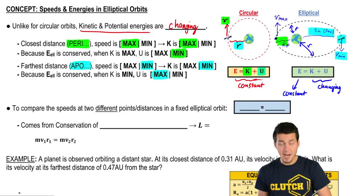
Elliptical orbits are the paths followed by celestial bodies, like planets, around a star, characterized by an elongated circle or oval shape. The shape of an ellipse is defined by its semimajor axis, which is the longest diameter, and its eccentricity, which measures the deviation from a perfect circle. Understanding elliptical orbits is crucial for calculating distances at various points in the orbit.
Recommended video:
Guided course
6:03
Speed and Energy of Elliptical Orbits

Semimajor Axis

The semimajor axis is half of the longest diameter of an ellipse and is a fundamental parameter in describing the size of an orbit. In celestial mechanics, it represents the average distance of a planet from the star it orbits. For Pluto, the semimajor axis is 5.91 * 10^12 meters, which helps determine its orbital characteristics, including the closest and farthest points from the Sun.
Recommended video:
Guided course
13:46
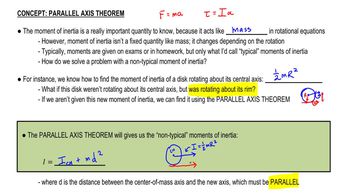
Parallel Axis Theorem

Orbital Eccentricity

Orbital eccentricity quantifies how much an orbit deviates from being circular, with values ranging from 0 (a perfect circle) to 1 (a parabolic trajectory). An eccentricity of 0.249 for Pluto indicates a moderately elliptical orbit. This value is essential for calculating the perihelion (closest point) and aphelion (farthest point) distances from the Sun, using the semimajor axis and eccentricity.
Recommended video:
Guided course
04:45
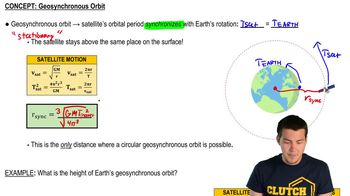
Geosynchronous Orbits
Related Practice
Textbook Question

In 2004 astronomers reported the discovery of a large Jupiter-sized planet orbiting very close to the star HD 179949 (hence the term 'hot Jupiter'). The orbit was just 1/9 the distance of Mercury from our sun, and it takes the planet only 3.09 days to make one orbit (assumed to be circular). How fast (in km/s) is this planet moving?

2803
views
Textbook Question

On October 15, 2001, a planet was discovered orbiting around the star HD 68988. Its orbital distance was measured to be 10.5 million kilometers from the center of the star, and its orbital period was estimated at 6.3 days. What is the mass of HD 68988? Express your answer in kilograms and in terms of our sun's mass.

2599
views
Textbook Question

In its orbit each day, the International Space Station makes 15.65 revolutions around the earth. Assuming a circular orbit, how high is this satellite above the surface of the earth?

3668
views
Textbook Question

A uniform, spherical, 1000.0-kg shell has a radius of 5.00 m. Find the gravitational force this shell exerts on a 2.00-kg point mass placed at the following distances from the center of the shell: (i) 5.01 m, (ii) 4.99 m, (iii) 2.72 m.

1767
views
Textbook Question

The star Rho1 Cancri is 57 light-years from the earth and has a mass 0.85 times that of our sun. A planet has been detected in a circular orbit around Rho1 Cancri with an orbital radius equal to 0.11 times the radius of the earth's orbit around the sun. What are (a) the orbital speed and (b) the orbital period of the planet of Rho1 Cancri?

2678
views
Textbook Question

In March 2006, two small satellites were discovered orbiting Pluto, one at a distance of 48,000 km and the other at 64,000 km. Pluto already was known to have a large satellite Charon, orbiting at 19,600 km with an orbital period of 6.39 days. Assuming that the satellites do not affect each other, find the orbital periods of the two small satellites without using the mass of Pluto.

2108
views