
Ch. 8 - Microbial Genetics
Tortora - Microbiology: An Introduction 14th Edition
Tortora14th EditionMicrobiology: An IntroductionISBN: 9780138200398Not the one you use?Change textbook
Chapter 8, Problem 9

Why are mutation and recombination important in the process of natural selection and the evolution of organisms?

Verified step by step guidance
1
Understand that mutation and recombination are sources of genetic variation within a population, which is essential for natural selection to act upon.
Recognize that mutations are random changes in the DNA sequence that can introduce new alleles (gene variants) into a population, potentially affecting an organism's traits.
Know that recombination occurs during sexual reproduction and involves the exchange of genetic material between homologous chromosomes, creating new combinations of alleles.
Realize that this genetic variation resulting from mutation and recombination provides a diverse pool of traits, some of which may offer a survival or reproductive advantage in a given environment.
Conclude that natural selection acts on this variation by favoring individuals with advantageous traits, leading to the evolution of populations over time.

Verified video answer for a similar problem:

This video solution was recommended by our tutors as helpful for the problem above.
Video duration:
3m
Was this helpful?

Key Concepts

Here are the essential concepts you must grasp in order to answer the question correctly.

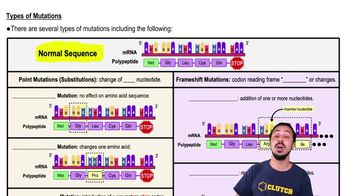
Mutation

Mutation refers to a change in the DNA sequence of an organism's genome. These changes can occur spontaneously or be induced by environmental factors. Mutations can lead to new traits, some of which may provide a survival advantage, thereby influencing the evolutionary process through natural selection.
Recommended video:
Guided course
08:44
Types of Mutations

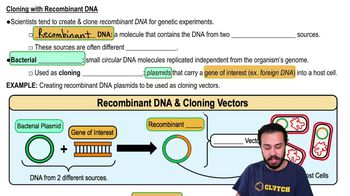
Recombination

Recombination is the process by which genetic material is shuffled during sexual reproduction, resulting in offspring with combinations of traits different from those of their parents. This genetic diversity is crucial for evolution, as it increases the variation within a population, allowing natural selection to act on a broader range of traits.
Recommended video:
Guided course
03:41
Cloning with Recombinant DNA

Natural Selection

Natural selection is the mechanism by which individuals with advantageous traits are more likely to survive and reproduce, passing those traits to the next generation. This process leads to the gradual adaptation of populations to their environments, shaping the evolution of species over time.
Recommended video:
Guided course
06:53
Natural Killer Cells