
Ch. 14 - Infection, Infectious Diseases, and Epidemiology
Bauman - Microbiology with Diseases by Taxonomy 6th Edition
Bauman6th EditionMicrobiology with Diseases by TaxonomyISBN: 9780134832302Not the one you use?Change textbook
Chapter 14, Problem 9

When pathogenic bacterial cells lose the ability to make adhesins, they typically                  .
a. Become avirulent
b. Produce endotoxin
c. Absorb endotoxin
d. Increase in virulence

Verified step by step guidance
1
Understand the role of adhesins in pathogenic bacteria: Adhesins are surface molecules that allow bacteria to attach to host cells, which is a critical first step in establishing infection.
Recognize that without adhesins, bacteria cannot effectively adhere to host tissues, which impairs their ability to colonize and cause disease.
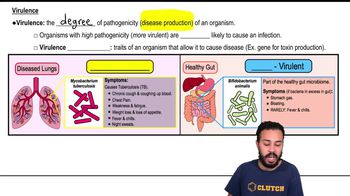
Recall that virulence refers to the degree of pathogenicity or the ability of a microorganism to cause disease.
Since adhesins are essential for attachment and colonization, losing the ability to produce adhesins typically results in a loss of virulence, meaning the bacteria become less capable of causing disease.
Therefore, the correct interpretation is that bacteria losing adhesin production usually become avirulent.

Verified video answer for a similar problem:

This video solution was recommended by our tutors as helpful for the problem above.
Video duration:
2m
Was this helpful?

Key Concepts

Here are the essential concepts you must grasp in order to answer the question correctly.

Adhesins and Their Role in Pathogenicity

Adhesins are surface molecules on pathogenic bacteria that enable them to attach to host cells. This attachment is crucial for colonization and infection. Without adhesins, bacteria cannot effectively adhere, reducing their ability to cause disease.
Recommended video:
Guided course
03:40
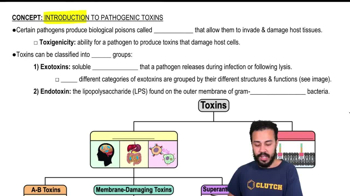
Introduction to Pathogenic Toxins

Virulence and Avirulence

Virulence refers to the degree of pathogenicity or the ability of a microbe to cause disease. Avirulence means the loss or absence of this ability. When bacteria lose key factors like adhesins, they often become avirulent, meaning they cannot effectively infect the host.
Recommended video:

Endotoxins and Their Production

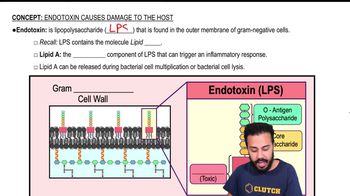
Endotoxins are toxic components of the outer membrane of Gram-negative bacteria, released when cells die or divide. Their production is independent of adhesin presence. Therefore, loss of adhesins does not directly cause bacteria to produce or absorb endotoxins.
Recommended video: