Ch. 16 - Innate Immunity: Nonspecific Defenses of the Host
Tortora - Microbiology: An Introduction 14th Edition
Tortora14th EditionMicrobiology: An IntroductionISBN: 9780138200398Not the one you use?Change textbook
Chapter 16, Problem 2

Chlamydia can prevent the formation of phagolysosomes and therefore can
a. avoid being phagocytized.
b. avoid destruction by complement.
c. prevent adherence.
d. avoid being digested.
e. none of the above

Verified step by step guidance
1
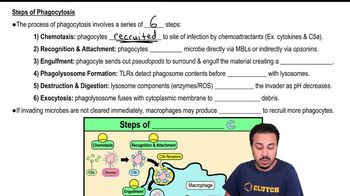
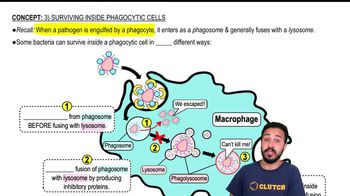
Understand the role of phagolysosomes in the immune response: Phagolysosomes are formed when a phagosome fuses with a lysosome inside a phagocytic cell, leading to the digestion and destruction of the engulfed microorganism.
Recognize that if Chlamydia can prevent the formation of phagolysosomes, it means it can interfere with the fusion process, thereby avoiding the environment where it would be digested by lysosomal enzymes.
Analyze each option in the context of this mechanism: (a) Avoid being phagocytized refers to preventing engulfment, which is different from preventing digestion after engulfment; (b) Avoid destruction by complement involves a different immune pathway unrelated to phagolysosome formation; (c) Prevent adherence relates to the initial attachment to host cells, not phagolysosome formation; (d) Avoid being digested directly relates to preventing phagolysosome formation and subsequent degradation.
Conclude that the correct understanding is that by preventing phagolysosome formation, Chlamydia avoids being digested inside the phagocytic cell.
Therefore, the best answer corresponds to the option that reflects avoidance of digestion after phagocytosis.

Verified video answer for a similar problem:

This video solution was recommended by our tutors as helpful for the problem above.
Video duration:
2m
Was this helpful?

Key Concepts

Here are the essential concepts you must grasp in order to answer the question correctly.

Phagocytosis and Phagolysosome Formation

Phagocytosis is the process by which immune cells engulf pathogens into vesicles called phagosomes. These phagosomes then fuse with lysosomes to form phagolysosomes, where the pathogen is exposed to destructive enzymes and reactive molecules, leading to its digestion and elimination.
Recommended video:
Guided course
08:57
Steps of Phagocytosis

Chlamydia's Intracellular Survival Mechanisms

Chlamydia is an intracellular bacterium that can inhibit the fusion of phagosomes with lysosomes, preventing phagolysosome formation. This allows it to evade destruction inside host cells by avoiding exposure to lysosomal enzymes, enabling its survival and replication.
Recommended video:
Guided course
04:18
Surviving Inside Phagocytic Cells

Immune Evasion Strategies

Pathogens use various strategies to evade the immune system, such as avoiding phagocytosis, resisting complement-mediated lysis, or preventing adherence to host cells. In Chlamydia's case, blocking phagolysosome formation specifically helps it avoid digestion rather than preventing phagocytosis or complement attack.
Recommended video:
Guided course
03:19
Immune Tolerance