Ch. 13 - Characterizing and Classifying Viruses, Viroids, and Prions
Bauman - Microbiology with Diseases by Taxonomy 6th Edition
Bauman6th EditionMicrobiology with Diseases by TaxonomyISBN: 9780134832302Not the one you use?Change textbook
Chapter 13, Problem 6

What is the difference between a virion and a virus particle?

Verified step by step guidance
1
Step 1: Understand the term 'virus particle' as a general term that refers to the complete virus structure, including its genetic material and protein coat, regardless of its state (inside or outside a host).
Step 2: Define 'virion' specifically as the fully assembled, infectious form of a virus that exists outside a host cell, capable of transmitting the viral genome to a new host.
Step 3: Recognize that while all virions are virus particles, not all virus particles are virions; for example, incomplete or immature virus particles inside a host cell are virus particles but not virions.
Step 4: Note that the virion includes the nucleic acid (DNA or RNA), the capsid (protein coat), and sometimes an envelope derived from the host cell membrane, making it the infectious extracellular form.
Step 5: Summarize that the key difference lies in the infectious capability and completeness: a virion is a mature, infectious virus particle outside the host cell, whereas 'virus particle' is a broader term that can include non-infectious or intracellular forms.

Verified video answer for a similar problem:

This video solution was recommended by our tutors as helpful for the problem above.
Video duration:
2m
Was this helpful?

Key Concepts

Here are the essential concepts you must grasp in order to answer the question correctly.

Virus Particle

A virus particle refers to the complete, infectious form of a virus outside a host cell. It includes the nucleic acid genome enclosed within a protein coat called the capsid, and sometimes an outer lipid envelope. Virus particles are capable of attaching to and entering host cells to initiate infection.
Recommended video:
Guided course
02:33
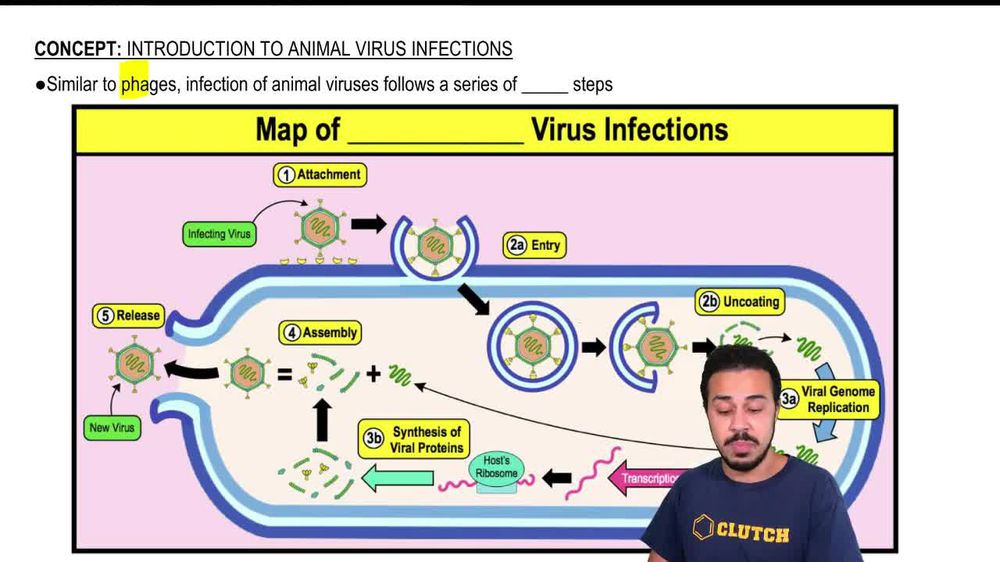
Introduction to Animal Virus Infections

Virion

A virion is the fully assembled, extracellular form of a virus that is infectious and capable of transmission between hosts. It is essentially synonymous with a virus particle, emphasizing the mature, complete structure ready to infect a new cell.
Recommended video:
Guided course
03:04
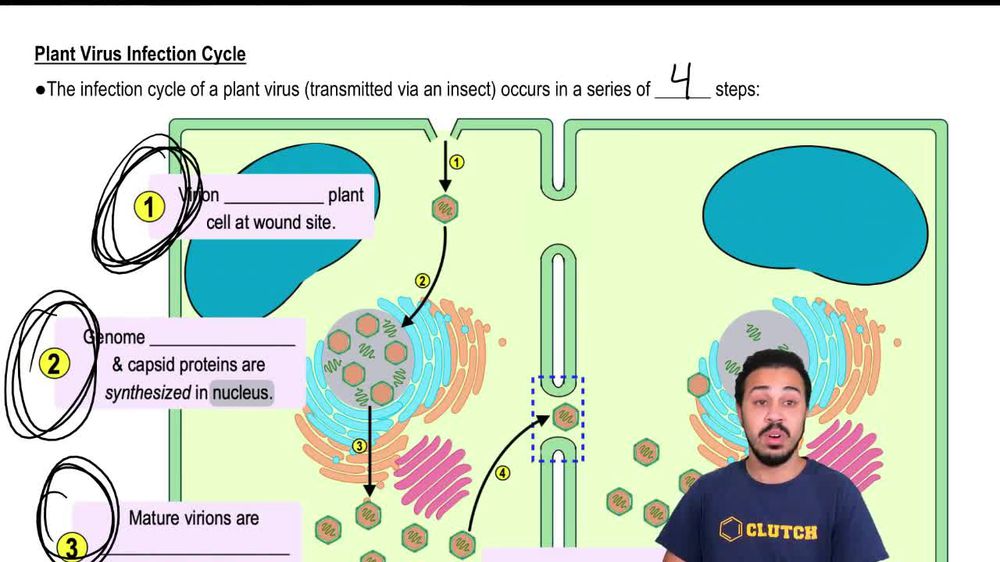
Plant VirusesPlant Virus Infection Cycle

Distinction Between Virion and Virus Particle

While often used interchangeably, 'virion' specifically denotes the infectious, mature virus particle outside the host, whereas 'virus particle' can sometimes refer more broadly to any virus form, including incomplete or non-infectious particles. Understanding this subtle difference clarifies discussions about virus structure and infectivity.
Recommended video:
Guided course
02:33
Introduction to Animal Virus Infections