Ch. 7 - Microbial Genetics
Bauman - Microbiology with Diseases by Taxonomy 6th Edition
Bauman6th EditionMicrobiology with Diseases by TaxonomyISBN: 9780134832302Not the one you use?Change textbook
Chapter 7, Problem 10

Explain the central dogma of genetics.

Verified step by step guidance
1
Start by defining the central dogma of genetics as the fundamental framework describing the flow of genetic information within a biological system.
Explain that the central dogma involves three main processes: replication, transcription, and translation.
Describe replication as the process where DNA makes an exact copy of itself, ensuring genetic information is passed to daughter cells.
Explain transcription as the process where the DNA sequence of a gene is copied into messenger RNA (mRNA), which serves as a temporary carrier of genetic information.
Describe translation as the process where the mRNA sequence is decoded by ribosomes to synthesize a specific protein, completing the flow of information from DNA to RNA to protein.

Verified video answer for a similar problem:

This video solution was recommended by our tutors as helpful for the problem above.
Video duration:
1m
Was this helpful?

Key Concepts

Here are the essential concepts you must grasp in order to answer the question correctly.

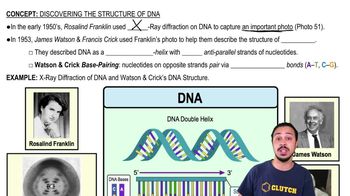
DNA Structure and Function

DNA is a double-stranded molecule that stores genetic information in the sequence of its nucleotides. It serves as the template for replication and provides the instructions for synthesizing proteins, which determine cellular functions.
Recommended video:
Guided course
04:41
Discovering the Structure of DNA

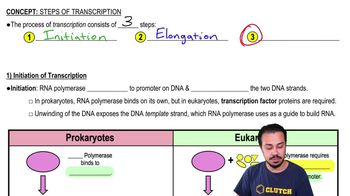
Transcription

Transcription is the process where the DNA sequence of a gene is copied into messenger RNA (mRNA). This step transfers genetic information from DNA in the nucleus to mRNA, which can then travel to the cytoplasm for protein synthesis.
Recommended video:
Guided course
04:16
Initiation of Transcription

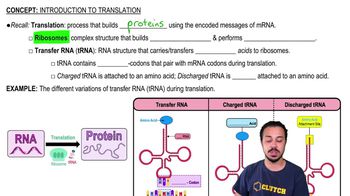
Translation

Translation is the process by which the mRNA sequence is decoded by ribosomes to assemble amino acids into a polypeptide chain, forming proteins. This step completes the flow of genetic information from nucleic acids to functional proteins.
Recommended video:
Guided course
06:12
Introduction to Translation