
Ch. 3 - Cell Structure and Function
Bauman - Microbiology with Diseases by Taxonomy 6th Edition
Bauman6th EditionMicrobiology with Diseases by TaxonomyISBN: 9780134832302Not the one you use?Change textbook
Chapter 3, Problem 10

Which cellular structure is important in classifying a bacterial species as Gram positive or Gram negative?


a. Flagella
b. Cell wall
c. Cilia
d. Glycocalyx

Verified step by step guidance
1
Understand that the classification of bacteria as Gram positive or Gram negative is based on differences in their cell envelope structure, particularly the cell wall.
Recall that Gram positive bacteria have a thick peptidoglycan layer in their cell wall, which retains the crystal violet stain during Gram staining, appearing purple under a microscope.
Recognize that Gram negative bacteria have a thinner peptidoglycan layer but possess an outer membrane containing lipopolysaccharides, which does not retain the crystal violet stain but takes up the counterstain (safranin), appearing pink or red.
Identify that other structures listed (flagella, cilia, glycocalyx) are not the primary basis for Gram classification, as they do not affect the staining properties related to the Gram stain.
Conclude that the cell wall is the key cellular structure used to classify bacteria as Gram positive or Gram negative.

Verified video answer for a similar problem:

This video solution was recommended by our tutors as helpful for the problem above.
Video duration:
2m
Was this helpful?

Key Concepts

Here are the essential concepts you must grasp in order to answer the question correctly.

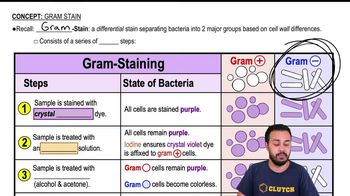
Gram Staining and Bacterial Classification

Gram staining is a differential staining technique that classifies bacteria into Gram positive or Gram negative based on their cell wall properties. This classification helps in identifying bacterial species and determining appropriate treatments.
Recommended video:

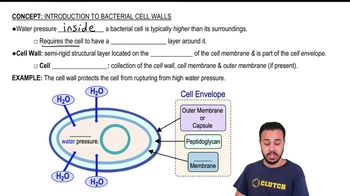
Bacterial Cell Wall Structure

The bacterial cell wall is a rigid layer that provides shape and protection. Gram positive bacteria have a thick peptidoglycan layer, while Gram negative bacteria have a thin peptidoglycan layer and an outer membrane, which affects their staining and antibiotic susceptibility.
Recommended video:
Guided course
03:44
Introduction to Bacterial Cell Walls

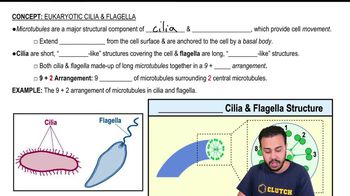
Role of Flagella, Cilia, and Glycocalyx

Flagella are tail-like structures for motility, cilia are hair-like projections (rare in bacteria), and glycocalyx is a protective polysaccharide layer. None of these structures determine Gram classification, which is primarily based on the cell wall.
Recommended video:
Guided course
02:36
Eukaryotic Cilia & Flagella