
Textbook Question
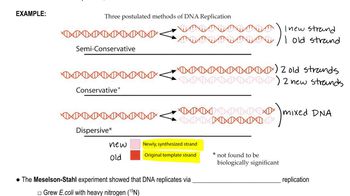
Compare conservative, semiconservative, and dispersive modes of DNA replication.
1299
views

 Verified step by step guidance
 14:31
14:31
 02:43
02:43 11:59
11:59Compare conservative, semiconservative, and dispersive modes of DNA replication.
In the discussion, we focused on how DNA is replicated and synthesized. We also discussed recombination at the DNA level. Along the way, we encountered many opportunities to consider how this information was acquired. On the basis of these discussions, what answers would you propose to the following fundamental questions?
What is the experimental basis for concluding that DNA replicates semiconservatively in both bacteria and eukaryotes?
In the discussion, we focused on how DNA is replicated and synthesized. We also discussed recombination at the DNA level. Along the way, we encountered many opportunities to consider how this information was acquired. On the basis of these discussions, what answers would you propose to the following fundamental questions?
How do we know that in vivo DNA synthesis occurs in the 5' to 3' direction?
In the discussion, we focused on how DNA is replicated and synthesized. We also discussed recombination at the DNA level. Along the way, we encountered many opportunities to consider how this information was acquired. On the basis of these discussions, what answers would you propose to the following fundamental questions?
How was it demonstrated that DNA synthesis occurs under the direction of DNA polymerase III and not polymerase I?
In the discussion, we focused on how DNA is replicated and synthesized. We also discussed recombination at the DNA level. Along the way, we encountered many opportunities to consider how this information was acquired. On the basis of these discussions, what answers would you propose to the following fundamental questions?
What observations reveal that a 'telomere problem' exists during eukaryotic DNA replication, and how did we learn of the solution to this problem?
Write a short essay that distinguishes between the terms replication and synthesis, as applied to DNA. Which of the two is most closely allied with the field of biochemistry?