Ch. 4 - Extensions of Mendelian Genetics
Klug - Concepts of Genetics  12th Edition
Klug12th EditionConcepts of Genetics ISBN: 9780135564776Not the one you use?Change textbook
Chapter 4, Problem 15b

With reference to the eye color phenotypes produced by the recessive, autosomal, unlinked brown and scarlet loci in Drosophila, predict the F₁ and F₂ results of the following P₁ crosses. (Recall that when both the brown and scarlet alleles are homozygous, no pigment is produced, and the eyes are white.)
Wild type x Scarlet

Verified step by step guidance
1
Step 1: Identify the genotypes of the parental (P₁) generation. The wild type fly has the genotype for normal pigmentation at both loci (let's denote it as 'bw⁺/bw⁺' and 'st⁺/st⁺'), while the scarlet fly is homozygous recessive at the scarlet locus ('st/st') but wild type at the brown locus ('bw⁺/bw⁺').
Step 2: Determine the gametes produced by each parent. The wild type fly can produce gametes with 'bw⁺' and 'st⁺' alleles, while the scarlet fly can produce gametes with 'bw⁺' and 'st' alleles.
Step 3: Predict the F₁ generation by combining the gametes from both parents. Each F₁ offspring will inherit one allele from each parent, resulting in the genotype 'bw⁺/bw⁺' and 'st⁺/st'. This genotype corresponds to a wild type phenotype because the 'st⁺' allele is dominant over 'st'.
Step 4: Predict the F₂ generation by performing a dihybrid cross of the F₁ individuals ('bw⁺/bw⁺' and 'st⁺/st'). Use a Punnett square to combine the alleles at both loci. The possible genotypes for the F₂ generation will include combinations of 'bw⁺/bw⁺', 'bw⁺/bw', 'bw/bw', and 'st⁺/st⁺', 'st⁺/st', 'st/st'.
Step 5: Interpret the phenotypes of the F₂ generation. Recall that the 'bw⁺' allele is dominant over 'bw', and the 'st⁺' allele is dominant over 'st'. Additionally, if both loci are homozygous recessive ('bw/bw' and 'st/st'), the eyes will be white due to the absence of pigment. Use the Punnett square results to determine the phenotypic ratios for wild type, scarlet, brown, and white eyes.

Verified video answer for a similar problem:

This video solution was recommended by our tutors as helpful for the problem above.
Video duration:
1m
Was this helpful?

Key Concepts

Here are the essential concepts you must grasp in order to answer the question correctly.

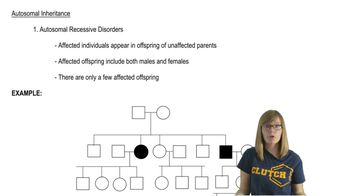
Autosomal Inheritance

Autosomal inheritance refers to the transmission of genes located on the autosomes, which are the non-sex chromosomes. In Drosophila, traits such as eye color are determined by alleles on these chromosomes. Understanding how these alleles segregate during gamete formation is crucial for predicting phenotypic ratios in offspring.
Recommended video:
Guided course
09:08
Autosomal Pedigrees

Recessive Alleles

Recessive alleles are variants of a gene that do not manifest in the phenotype unless two copies are present (homozygous condition). In the context of the question, the brown and scarlet loci are recessive, meaning that the wild type phenotype will appear in the presence of a dominant allele, while the recessive traits will only be expressed when both alleles are recessive.
Recommended video:
Guided course
03:03
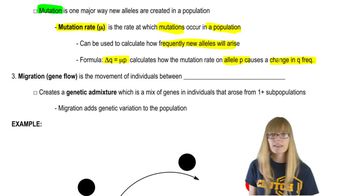
New Alleles and Migration

Punnett Square

A Punnett square is a diagram used to predict the genotypic and phenotypic outcomes of a genetic cross. By organizing the alleles of the parents, it allows for a visual representation of how traits may be inherited in the offspring. This tool is essential for calculating the expected ratios of phenotypes in the F₁ and F₂ generations based on the parental genotypes.
Recommended video:
Guided course
18:27
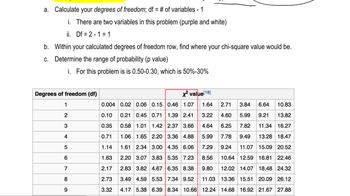
Chi Square Analysis
Related Practice
Textbook Question

With reference to the eye color phenotypes produced by the recessive, autosomal, unlinked brown and scarlet loci in Drosophila, predict the F₁ and F₂ results of the following P₁ crosses. (Recall that when both the brown and scarlet alleles are homozygous, no pigment is produced, and the eyes are white.)

Wild type x White

564
views
Textbook Question

Pigment in mouse fur is only produced when the C allele is present. Individuals of the cc genotype are white. If color is present, it may be determined by the A, a alleles. AA or Aa results in agouti color, while aa results in black coats. In three crosses between agouti females whose genotypes were unknown and males of the aacc genotype, the following phenotypic ratios were obtained:

(1) 8 agouti

(2) 9 agouti

(3) 4 agouti, 8 white 10 black, 5 black, 10 white

1072
views
Textbook Question

Horses can be cremello (a light cream color), chestnut (a brownish color), or palomino (a golden color with white in the horse's tail and mane). Of these phenotypes, only palominos never breed true.

From the results given above, determine the mode of inheritance by assigning gene symbols and indicating which genotypes yield which phenotypes.

1087
views
Textbook Question

With reference to the eye color phenotypes produced by the recessive, autosomal, unlinked brown and scarlet loci in Drosophila, predict the F₁ and F₂ results of the following P₁ crosses. (Recall that when both the brown and scarlet alleles are homozygous, no pigment is produced, and the eyes are white.)

Brown x White

524
views
Textbook Question

Horses can be cremello (a light cream color), chestnut (a brownish color), or palomino (a golden color with white in the horse's tail and mane). Of these phenotypes, only palominos never breed true.

Predict the F1 and F2 results of many initial matings between cremello and chestnut horses.

548
views
Textbook Question

Pigment in mouse fur is only produced when the C allele is present. Individuals of the cc genotype are white. If color is present, it may be determined by the A, a alleles. AA or Aa results in agouti color, while aa results in black coats. What F₁ and F₂ genotypic and phenotypic ratios are obtained from a cross between AACC and aacc mice?

756
views