Pearson+ LogoPearson+ Logo
Ch. 6 - Genetic Analysis and Mapping in Bacteria and Bacteriophages
Klug - Concepts of Genetics  12th Edition
Klug12th EditionConcepts of Genetics ISBN: 9780135564776Not the one you use?Change textbook
Chapter 6, Problem 12

Define plaque, lysogeny, and prophage.

Verified step by step guidance
1
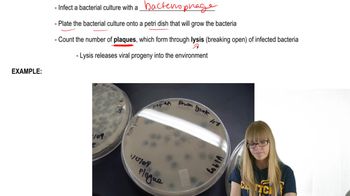
Define 'plaque' as a clear zone on a bacterial lawn where bacteriophages have infected and lysed the bacterial cells, indicating areas of cell destruction caused by viral infection.
Explain 'lysogeny' as a viral life cycle in which the bacteriophage integrates its genome into the host bacterial chromosome, existing in a dormant state without causing immediate lysis of the host cell.
Describe 'prophage' as the viral DNA that has been integrated into the bacterial genome during lysogeny, which can replicate along with the host DNA and remain latent until induced to enter the lytic cycle.
Clarify that plaques are visible evidence of the lytic cycle, whereas lysogeny and prophage represent a dormant phase of the virus within the host.
Summarize the relationship: plaques result from lytic infection, lysogeny is the dormant integration phase, and prophage is the integrated viral DNA within the host genome.

Verified video answer for a similar problem:

This video solution was recommended by our tutors as helpful for the problem above.
Video duration:
1m
Was this helpful?

Key Concepts

Here are the essential concepts you must grasp in order to answer the question correctly.

Plaque

A plaque is a clear zone formed on a bacterial lawn where bacteriophages have infected and lysed bacterial cells. It represents areas of bacterial cell death caused by viral replication and release, useful for quantifying phage particles.
Recommended video:
Guided course
03:44
Plaques and Experiments

Lysogeny

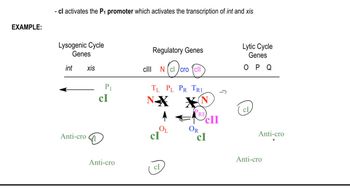
Lysogeny is a viral life cycle in which a bacteriophage integrates its genome into the host bacterial chromosome, remaining dormant as a prophage. The host cell continues to live and reproduce, passing the viral DNA to daughter cells.
Recommended video:
Guided course
08:04
Decision Between Lytic and Lysogenic Cycles

Prophage

A prophage is the viral DNA integrated into the bacterial genome during lysogeny. It remains inactive but can later be induced to enter the lytic cycle, producing new phages and lysing the host cell.
Recommended video:
Guided course
03:44
Plaques and Experiments
Related Practice
Textbook Question

In a transformation experiment, donor DNA was obtained from a prototroph bacterial strain (a⁺b⁺c⁺), and the recipient was a triple auxotroph (a⁻b⁻c⁻). What general conclusions can you draw about the linkage relationships among the three genes from the following transformant classes that were recovered?

1393
views
Textbook Question

Describe the role of heteroduplex formation during transformation.

919
views
Textbook Question

Explain the observations that led Zinder and Lederberg to conclude that the prototrophs recovered in their transduction experiments were not the result of F⁺ mediated conjugation.

1013
views
Textbook Question

Two theoretical genetic strains of a virus (a⁻b⁻c⁻ and a⁺b⁺c⁺) were used to simultaneously infect a culture of host bacteria. Of 10,000 plaques scored, the following genotypes were observed. Determine the genetic map of these three genes on the viral chromosome. Decide whether the interference was positive or negative.

598
views
Textbook Question

The bacteriophage genome consists of many genes encoding proteins that make up the head, collar, tail, and tail fibers. When these genes are transcribed following phage infection, how are these proteins synthesized, since the phage genome lacks genes essential to ribosome structure?

1026
views
Textbook Question

If a single bacteriophage infects one E. coli cell present on a lawn of bacteria and, upon lysis, yields 200 viable viruses, how many phages will exist in a single plaque if three more lytic cycles occur?

1131
views