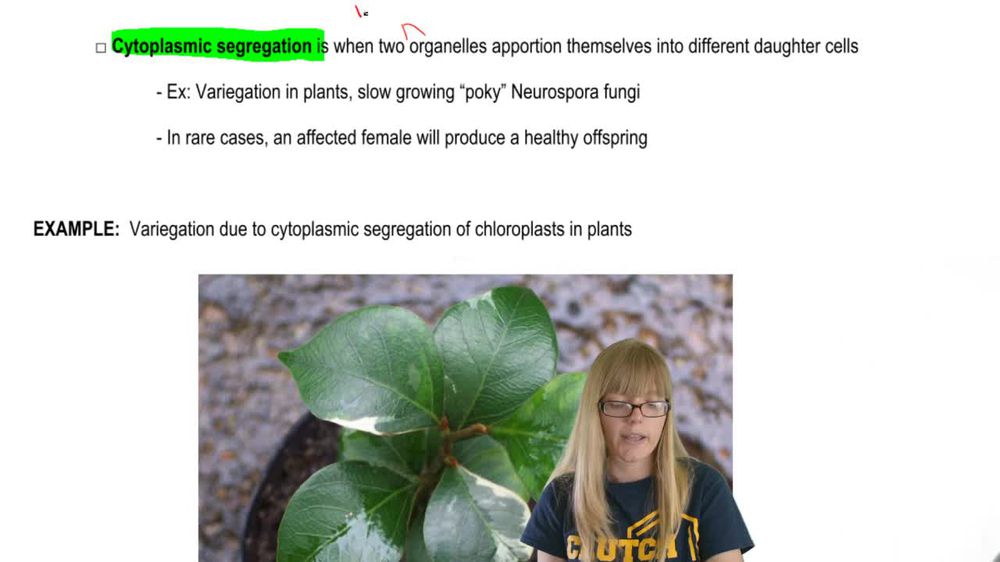
Streptomycin resistance in Chlamydomonas may result from a mutation in either a chloroplast gene or a nuclear gene. What phenotypic results would occur in a cross between a member of an mt⁺ strain resistant in both genes and a member of a strain sensitive to the antibiotic? What results would occur in the reciprocal cross?

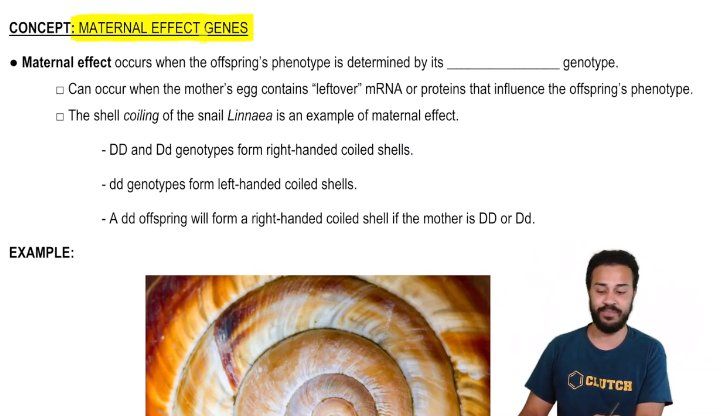
Write a short essay that distinguishes between organelle heredity and maternal effect.
Verified step by step guidance
Verified video answer for a similar problem:
Key Concepts
Organelle Heredity
Maternal Effect
Differences in Inheritance Patterns
In the discussion, we focused on extranuclear inheritance and how traits can be determined by genetic information contained in mitochondria and chloroplasts, and we discussed how expression of maternal genotypes can affect the phenotype of an organism. At the same time, we found many opportunities to consider the methods and reasoning by which much of this information was acquired. From the explanations given in the chapter, what answers would you propose to the following fundamental questions?
What observations support the endosymbiotic theory?
In the discussion, we focused on extranuclear inheritance and how traits can be determined by genetic information contained in mitochondria and chloroplasts, and we discussed how expression of maternal genotypes can affect the phenotype of an organism. At the same time, we found many opportunities to consider the methods and reasoning by which much of this information was acquired. From the explanations given in the chapter, what answers would you propose to the following fundamental questions?
What findings demonstrate a maternal effect as the basis of a mode of inheritance?
In diploid yeast strains, sporulation and subsequent meiosis can produce haploid ascospores, which may fuse to reestablish diploid cells. When ascospores from a segregational petite strain fuse with those of a normal wild-type strain, the diploid zygotes are all normal. Following meiosis, ascospores are petite and normal. Is the segregational petite phenotype inherited as a dominant or a recessive trait?
A plant may have green, white, or green-and-white (variegated) leaves on its branches, owing to a mutation in the chloroplast that prevents color from developing. Predict the results of the following crosses:
Ovule Source Pollen Source
(a) Green branch x White branch
(b) White branch x Green branch
(c) Variegated branch x Green branch
(d) Green branch x Variegated branch
In the discussion, we focused on extranuclear inheritance and how traits can be determined by genetic information contained in mitochondria and chloroplasts, and we discussed how expression of maternal genotypes can affect the phenotype of an organism. At the same time, we found many opportunities to consider the methods and reasoning by which much of this information was acquired. From the explanations given in the chapter, what answers would you propose to the following fundamental questions?
What key observations in crosses between dextrally and sinistrally coiled snails support the explanation that this phenotype is the result of maternal-effect inheritance?
