20. Electrochemistry
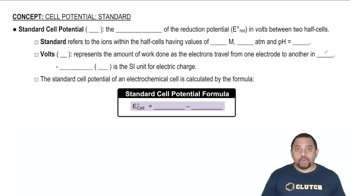
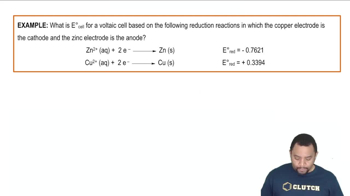
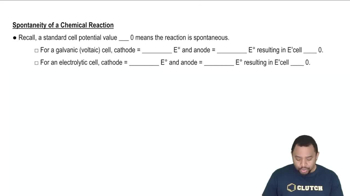
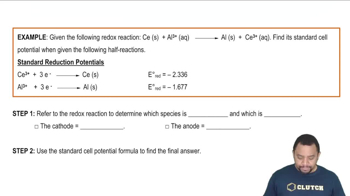
Cell Potential: Standard
 01:27
01:27

Practice this topic
- Multiple Choice
Calculate the standard cell potential of an electrolytic cell when given the following half reactions.
Standard Reduction Potentials
Fe3+ (aq) + e – → Fe2+ (aq) E°red = + 0.769 V
Li+ (aq) + e – → Li (s) E°red = – 3.04 V
1217views12rank - Multiple Choice
Use the standard half-cell potentials listed below to calculate the standard cell potential for the following reaction occurring in an electrochemical cell at 25°C.
3 Cl2 (g) + 2 Fe (s) → 6 Cl – (aq) + 2 Fe3+ (aq)
Standard Reduction Potentials
Cl2 (g) + 2 e– → 2 Cl – (aq) E°red = + 1.396 V
Fe3+ (aq) + 3 e– → Fe (s) E°red = – 0.040 V1313views2rank1comments - Multiple Choice
Predict whether the following reaction will occur as written based on the calculated Eºcell.
Ag+ (aq) + Au (s) → Ag (s) + Au3+ (aq)
Standard Reduction Potentials
Ag+(aq) + e– → Ag (s) E°red = + 0.80 V
Au3+ (aq) + 3 e– → Au (s) E°red = + 1.50 V1167views4rank - Open Question
H2(g) + F2(g) → 2 H+(aq) + 2 F−(aq).
1324views - Open Question
What species is/are formed at the anode of the alkaline fuel cell?
1078views - Open Question
Use the standard half-cell potentials listed below to calculate the standard cell potential for the following reaction occurring in an electrochemical cell at 25°C. (The equation is balanced.) 3 Cl2(g) + 2 Fe(s) → 6 Cl-(aq) + 2 Fe3+(aq) Cl2(g) + 2 e- → 2 Cl-(aq) E° = +1.36 V Fe3+(aq) + 3 e- → Fe(s) E° = -0.04 V
1466views - Open Question
Determine E° (cell) for the reaction Al(s) + 3 Ag+(aq) → 3 Ag(s) + Al3+(aq).
1821views - Multiple ChoiceCalculate the standard cell potential for the following reaction: Mg (s) + Cu²⁺ (aq) → Cu (s) + Mg²⁺ (aq). Given the standard reduction potentials: Cu²⁺ (aq) + 2 e⁻ → Cu (s) is 0.34 V and Mg²⁺ (aq) + 2 e⁻ → Mg (s) is -2.37 V.974views