Ch. 13 The Peripheral Nervous System and Reflex Activity
Marieb - Human Anatomy & Physiology 7th Edition
Marieb, Hoehn7th EditionHuman Anatomy & PhysiologyISBN: 9780805359091Not the one you use?Change textbook
Chapter 13, Problem 35

What is the structural and functional relationship between spinal nerves, skeletal muscles, and dermatomes?

Verified step by step guidance
1
Understand that spinal nerves are mixed nerves that emerge from the spinal cord and contain both motor and sensory fibers. These nerves play a crucial role in connecting the central nervous system to the peripheral structures.
Recognize that skeletal muscles receive motor innervation from specific spinal nerves. Each spinal nerve controls the contraction of certain muscles, enabling voluntary movement. This motor function is essential for muscle control and coordination.
Learn that dermatomes are specific areas of skin innervated by sensory fibers from a single spinal nerve. Each dermatome corresponds to a particular spinal nerve, allowing the mapping of sensory input from the skin to the spinal cord.
Explore the functional relationship: spinal nerves transmit motor commands to skeletal muscles and carry sensory information from dermatomes back to the spinal cord. This bidirectional communication allows for coordinated motor responses and sensory perception.
Summarize the structural relationship: spinal nerves physically connect the spinal cord to both skeletal muscles (via motor fibers) and dermatomes (via sensory fibers), establishing an integrated system for movement and sensation.

Verified video answer for a similar problem:

This video solution was recommended by our tutors as helpful for the problem above.
Video duration:
2m
Was this helpful?

Key Concepts

Here are the essential concepts you must grasp in order to answer the question correctly.

Spinal Nerves

Spinal nerves are mixed nerves that emerge from the spinal cord, carrying motor, sensory, and autonomic signals between the spinal cord and the body. Each spinal nerve innervates specific muscles and skin regions, playing a crucial role in transmitting information for movement and sensation.
Recommended video:
4:04
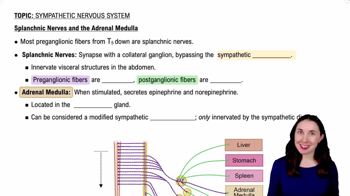
Splanchnic Nerves and the Adrenal Medulla

Skeletal Muscles Innervation

Skeletal muscles receive motor innervation from spinal nerves, which control voluntary muscle contractions. The motor neurons in the spinal cord send signals through spinal nerves to specific muscles, enabling coordinated movement and reflexes.
Recommended video:
Guided course
2:46
Structure of a Skeletal Muscle Example 2

Dermatomes

Dermatomes are areas of skin innervated by sensory fibers from a single spinal nerve. They map the sensory distribution of spinal nerves on the body surface, helping to diagnose nerve damage or spinal cord injuries based on sensory loss patterns.