Textbook Question
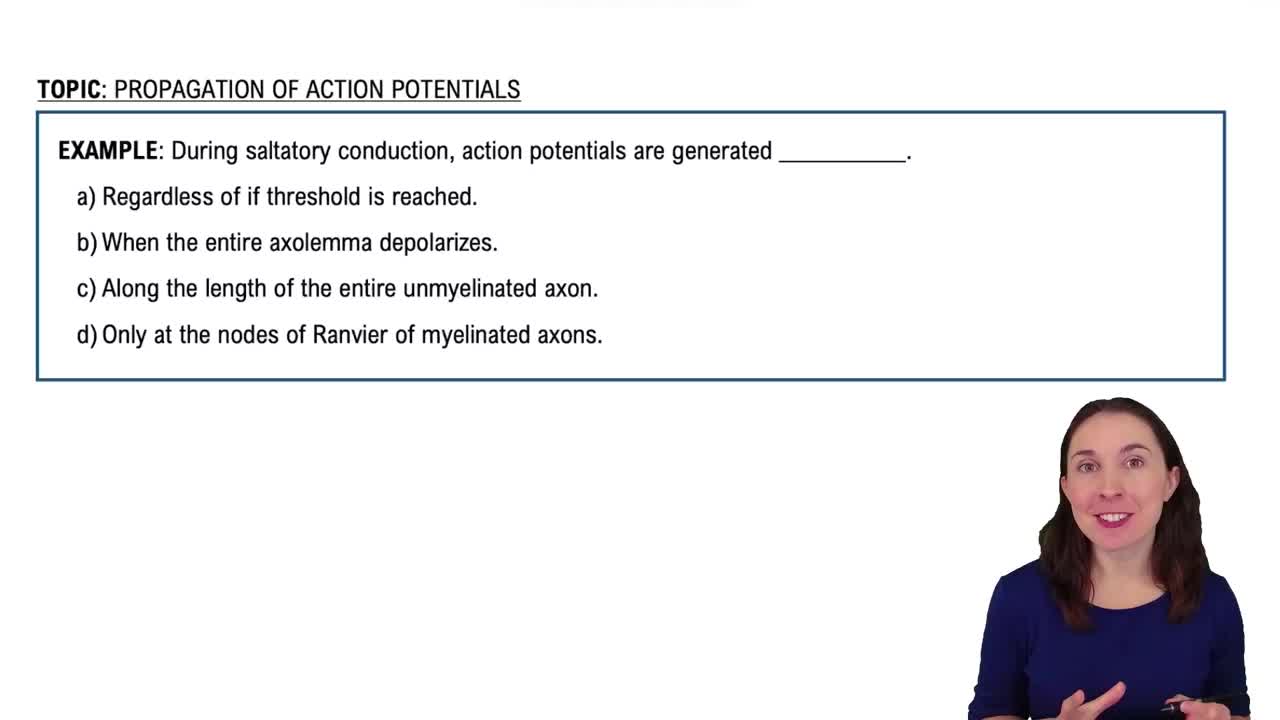
During a neurobiology lecture, a professor repeatedly refers to group A and group B fibers, absolute refractory period, and myelin sheath gaps. Define these terms.
632
views
1
rank

 Marieb, Hoehn 7th EditionCh. 11 Fundamentals of the Nervous System and Nervous TissueProblem 11
 Verified step by step guidance
 02:01
02:01
 1:32
1:32 3:33
3:33During a neurobiology lecture, a professor repeatedly refers to group A and group B fibers, absolute refractory period, and myelin sheath gaps. Define these terms.
The velocity of nerve impulse conduction is greatest in
a. Heavily myelinated, large-diameter fibers
b. Myelinated, small-diameter fibers
c. Nonmyelinated, small-diameter fibers
d. Nonmyelinated, large-diameter fibers
An IPSP is inhibitory because
a. It hyperpolarizes the postsynaptic membrane.
b. It reduces the amount of neurotransmitter released by the presynaptic terminal.
c. It prevents calcium ion entry into the presynaptic terminal.
d. It changes the threshold of the neuron.
Inhibition of acetylcholinesterase by poisoning blocks neurotransmission at the neuromuscular junction because
a. ACh is no longer released by the presynaptic terminal.
b. ACh synthesis in the presynaptic terminal is blocked.
c. ACh is not degraded, so prolonged depolarization is enforced on the postsynaptic cell.
d. ACh is blocked from attaching to the postsynaptic ACh receptors.
The anatomical region of a multipolar neuron where the AP is initiated is the
a. Soma
b. Dendrites
c. Axon's initial segment
d. Axon terminals
Since all APs generated by a given nerve fiber have the same magnitude, how does the CNS 'know' whether a stimulus is strong or weak?