Ch. 20 The Lymphatic System and Lymphoid Organs and Tissues
Marieb - Human Anatomy & Physiology 7th Edition
Marieb, Hoehn7th EditionHuman Anatomy & PhysiologyISBN: 9780805359091Not the one you use?Change textbook
Chapter 19, Problem 14

There are no lymphatic arteries. Why isn't this a problem?

Verified step by step guidance
1
Step 1: Understand the structure of the lymphatic system, which consists of lymphatic capillaries, larger lymphatic vessels, lymph nodes, and ducts, but notably lacks arteries.
Step 2: Recognize that lymphatic vessels do not require arteries because they do not need to actively pump lymph; instead, lymph movement relies on other mechanisms.
Step 3: Identify the mechanisms that propel lymph through the lymphatic vessels, such as skeletal muscle contractions, respiratory movements, and the presence of one-way valves preventing backflow.
Step 4: Note that lymphatic capillaries are highly permeable and absorb interstitial fluid directly, so there is no need for a high-pressure arterial system to deliver lymph.
Step 5: Conclude that the absence of lymphatic arteries is not a problem because lymph flow depends on passive and mechanical forces rather than arterial pressure, making arteries unnecessary in the lymphatic system.

Verified video answer for a similar problem:

This video solution was recommended by our tutors as helpful for the problem above.
Video duration:
2m
Was this helpful?

Key Concepts

Here are the essential concepts you must grasp in order to answer the question correctly.

Structure and Function of Lymphatic Vessels

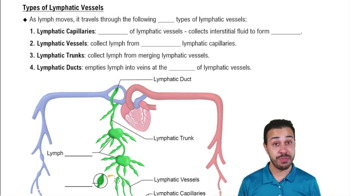
Lymphatic vessels are responsible for transporting lymph fluid throughout the body. Unlike blood vessels, lymphatic vessels have thin walls and valves to prevent backflow, ensuring one-way movement of lymph. They begin as blind-ended capillaries and progressively merge into larger vessels, but there are no arteries because lymph is not pumped under high pressure.
Recommended video:
7:02
Types of Lymphatic Vessels

Role of Muscle Contractions and Valves in Lymph Flow

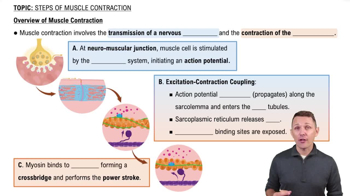
Lymph flow relies on the contraction of surrounding skeletal muscles and the presence of valves within lymphatic vessels. These valves prevent backflow, and muscle movements compress the vessels, pushing lymph forward. This mechanism compensates for the absence of lymphatic arteries and a central pump like the heart.
Recommended video:
Guided course
4:53
Overview of Muscle Contraction

Differences Between Blood Circulation and Lymphatic Circulation

Blood circulation is a closed loop driven by the heart, involving arteries, veins, and capillaries. In contrast, the lymphatic system is an open network without arteries and relies on passive mechanisms for fluid movement. This difference explains why lymphatic arteries are unnecessary and not present.
Recommended video:
Guided course
03:04
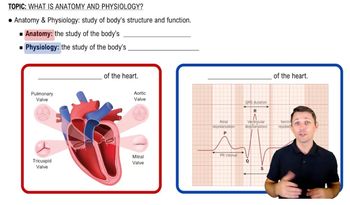
The Difference Between Anatomy and Physiology