
Ch. 26 Fluid, Electrolyte, and Acid-Base Balance
Marieb - Human Anatomy & Physiology 7th Edition
Marieb, Hoehn7th EditionHuman Anatomy & PhysiologyISBN: 9780805359091Not the one you use?Change textbook
Chapter 25, Problem 18

Explain how the chemical buffer systems resist changes in pH.

Verified step by step guidance
1
Understand that chemical buffer systems help maintain pH stability by minimizing changes in hydrogen ion concentration (H\_3O\^+ or H\^+).
Recognize that a buffer system typically consists of a weak acid and its conjugate base, which can react with added acids or bases to neutralize them.
When an acid (H\^+) is added, the conjugate base component of the buffer reacts with the excess H\^+ ions to form the weak acid, thus reducing the increase in free hydrogen ions and limiting pH change.
When a base (OH\^-) is added, the weak acid component of the buffer donates H\^+ ions to react with OH\^- ions, forming water and reducing the increase in hydroxide ions, again stabilizing the pH.
Overall, the buffer system shifts the equilibrium between the weak acid and conjugate base to absorb excess H\^+ or OH\^- ions, thereby resisting large fluctuations in pH.

Verified video answer for a similar problem:

This video solution was recommended by our tutors as helpful for the problem above.
Video duration:
1m
Was this helpful?

Key Concepts

Here are the essential concepts you must grasp in order to answer the question correctly.

Chemical Buffer Systems

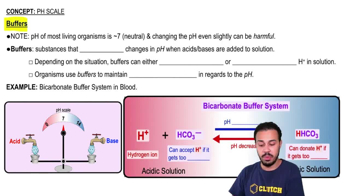
Chemical buffer systems are solutions that minimize changes in pH when acids or bases are added. They typically consist of a weak acid and its conjugate base, or a weak base and its conjugate acid, which work together to neutralize added H+ or OH- ions.
Recommended video:
05:38
Buffers

Mechanism of pH Resistance

Buffers resist pH changes by reacting with added hydrogen ions (H+) or hydroxide ions (OH-). The weak acid component donates H+ when a base is added, while the conjugate base accepts H+ when an acid is added, maintaining the solution’s pH within a narrow range.
Recommended video:
07:58
pH Scale

Physiological Importance of Buffers

In biological systems, buffer systems like the bicarbonate buffer maintain stable pH essential for enzyme function and metabolic processes. They help prevent harmful shifts in blood and cellular pH, ensuring proper physiological function.
Recommended video:
05:38
Buffers