Ch. 26 Fluid, Electrolyte, and Acid-Base Balance
Marieb - Human Anatomy & Physiology 7th Edition
Marieb, Hoehn7th EditionHuman Anatomy & PhysiologyISBN: 9780805359091Not the one you use?Change textbook
Chapter 25, Problem 15

Explain why and how ECF osmolality is maintained.

Verified step by step guidance
1
Step 1: Understand that ECF (extracellular fluid) osmolality refers to the concentration of solutes, mainly sodium, glucose, and urea, in the extracellular fluid, which affects water movement between compartments.
Step 2: Recognize that maintaining ECF osmolality is crucial for cell volume regulation, as changes in osmolality cause water to move into or out of cells by osmosis, potentially leading to cell swelling or shrinkage.
Step 3: Identify the primary mechanisms that regulate ECF osmolality, including thirst response and antidiuretic hormone (ADH) secretion, which control water intake and water reabsorption in the kidneys respectively.
Step 4: Explain that when ECF osmolality increases (e.g., dehydration), osmoreceptors in the hypothalamus detect this change, triggering thirst to increase water intake and stimulating ADH release to promote water reabsorption in the kidneys, diluting the ECF.
Step 5: Conversely, when ECF osmolality decreases (e.g., overhydration), ADH secretion is suppressed, leading to decreased water reabsorption and increased urine output, which helps restore normal osmolality.

Verified video answer for a similar problem:

This video solution was recommended by our tutors as helpful for the problem above.
Video duration:
6m
Was this helpful?

Key Concepts

Here are the essential concepts you must grasp in order to answer the question correctly.

Extracellular Fluid (ECF) Osmolality

ECF osmolality refers to the concentration of solutes, such as sodium and other electrolytes, in the extracellular fluid. It determines the movement of water between body compartments and is crucial for maintaining cellular function and fluid balance.
Recommended video:
Guided course
2:39
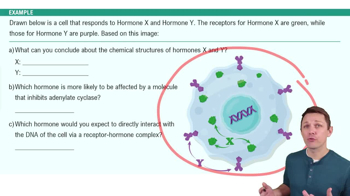
Intracellular Receptors and Direct Gene Action Example 1

Homeostatic Mechanisms Regulating Osmolality

The body maintains ECF osmolality through homeostatic mechanisms involving osmoreceptors, antidiuretic hormone (ADH), and thirst. When osmolality rises, ADH release increases water reabsorption in the kidneys, diluting the ECF and restoring balance.
Recommended video:
1:52
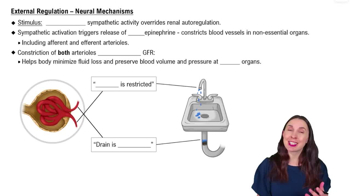
External Regulation – Neural Mechanisms

Importance of Maintaining ECF Osmolality

Maintaining stable ECF osmolality is vital to prevent cellular dehydration or swelling, which can impair cell function. Proper osmolality ensures optimal enzyme activity, nerve conduction, and overall physiological stability.
Recommended video:
03:18
Importance of Cell Division