Ch. 25 The Urinary System
Marieb - Human Anatomy & Physiology 7th Edition
Marieb, Hoehn7th EditionHuman Anatomy & PhysiologyISBN: 9780805359091Not the one you use?Change textbook
Chapter 24, Problem 2

The glomerular capillaries differ from other capillary networks in the body because they
a. Have a larger area of anastomosis
b. Are derived from and drain into arterioles
c. Are not made of endothelium
d. Are sites of filtrate formation

Verified step by step guidance
1
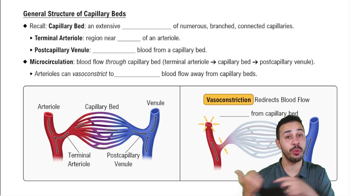
Step 1: Understand the structure of typical capillary networks in the body. Normally, capillaries connect arterioles to venules, allowing exchange of gases, nutrients, and waste between blood and tissues.
Step 2: Recognize that glomerular capillaries are unique because they are part of the kidney's filtration system. Unlike typical capillaries, they are involved in forming filtrate from blood plasma.
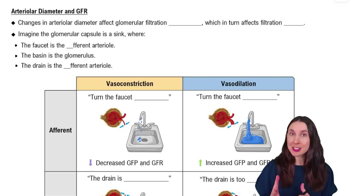
Step 3: Note that glomerular capillaries are unusual in that they are both supplied and drained by arterioles (afferent and efferent arterioles), which helps maintain high pressure for filtration.
Step 4: Recall that glomerular capillaries are made of endothelial cells, like other capillaries, so option c is incorrect.
Step 5: Conclude that the key distinguishing feature is that glomerular capillaries are sites of filtrate formation, which is essential for kidney function.

Verified video answer for a similar problem:

This video solution was recommended by our tutors as helpful for the problem above.
Video duration:
2m
Was this helpful?

Key Concepts

Here are the essential concepts you must grasp in order to answer the question correctly.

Structure of Glomerular Capillaries

Glomerular capillaries are unique because they are fenestrated, allowing selective filtration of blood plasma. Unlike typical capillaries, they are specialized for filtration rather than nutrient exchange, which is essential for kidney function.
Recommended video:
5:59
General Structure of Capillary Beds

Afferent and Efferent Arterioles

Glomerular capillaries are unusual in that they are both supplied and drained by arterioles—the afferent arteriole brings blood in, and the efferent arteriole carries it away. This arrangement helps regulate blood pressure and filtration rate within the glomerulus.
Recommended video:
4:33
Arteriolar Diameter and GFR

Filtrate Formation in the Kidney

The primary function of glomerular capillaries is to filter blood plasma, forming the initial filtrate that will become urine. This filtration occurs due to pressure differences and selective permeability, distinguishing these capillaries from others in the body.
Recommended video:
1:01
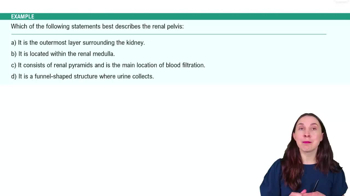
The Kidneys Example 2